From Physical Distribution to Behavioral Infrastructure
Context
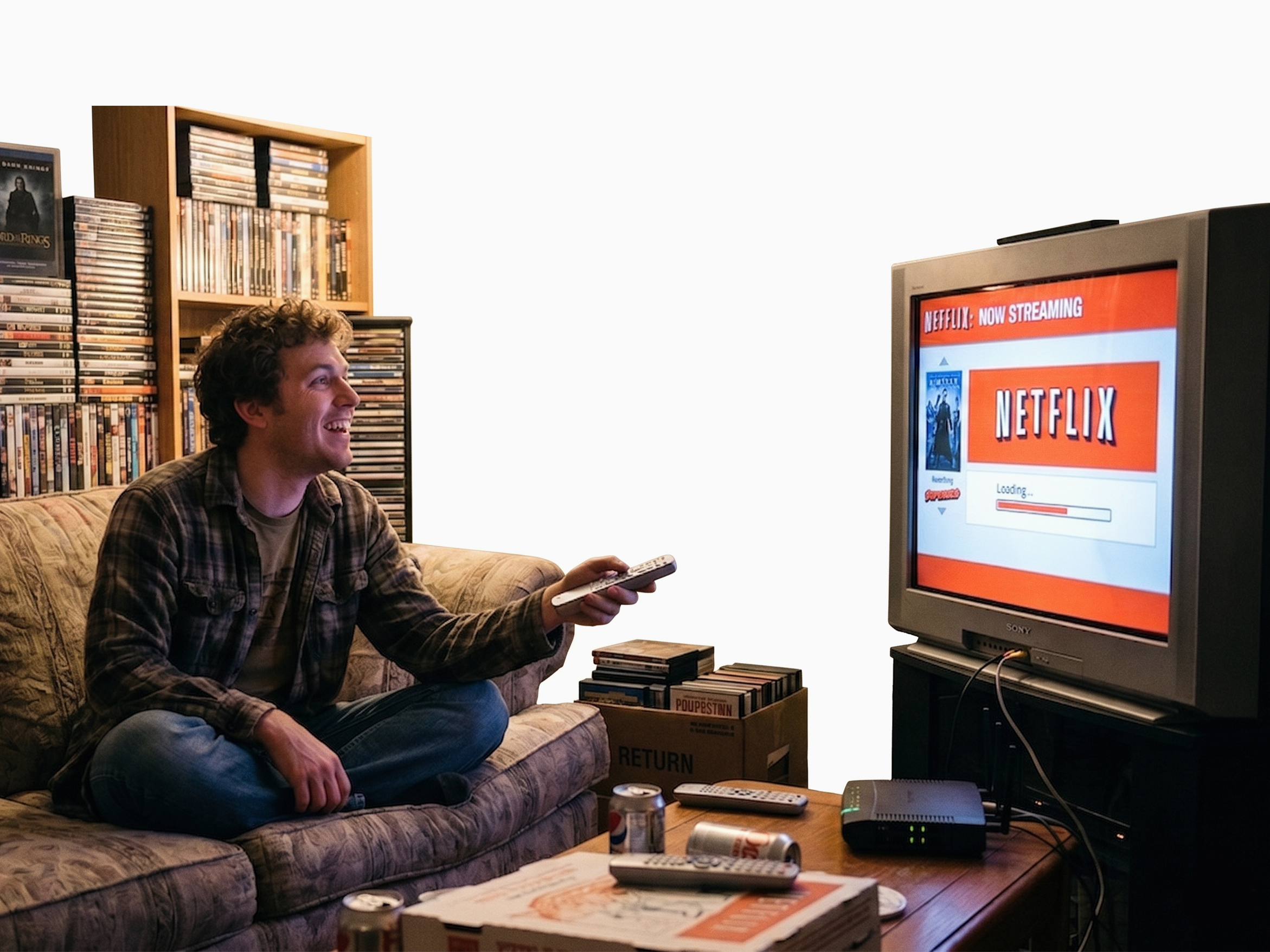
In 2007, Netflix introduced “Watch Now,” allowing subscribers to stream films and television content instantly over the internet rather than waiting for physical DVDs to arrive in the mail.
At the time, Netflix was still primarily associated with its DVD subscription business. The company had already weakened traditional rental friction through:
- no late fees,
- subscription access,
- and home delivery convenience.
But the streaming rollout represented something structurally different.
This was not merely a format upgrade from physical to digital distribution. It was the beginning of a transition from ownership-based entertainment consumption toward persistent on-demand access.
Broadband adoption was accelerating, consumer tolerance for friction was declining, and media consumption habits were becoming increasingly digital. Netflix recognized that the next competitive layer would not be distribution efficiency alone.
It would be behavioral immediacy.
Strategic Intent
The streaming launch was designed to remove entertainment latency almost entirely.
DVD delivery had already eliminated store visits. Streaming removed waiting itself.
That shift mattered because Netflix was no longer optimizing rental logistics. It was beginning to optimize consumption frequency.
The strategic objective was not simply:
“deliver movies digitally.”
The deeper objective was:
make entertainment access continuous, frictionless, and habitual.
Importantly, Netflix did not force consumers into a disruptive ecosystem reset. Streaming was layered onto the existing subscription structure rather than replacing it immediately.
That sequencing reduced behavioral resistance significantly.
Consumers did not feel they were entering a new system.
They felt the old system was becoming easier.
This was one of the launch’s strongest architectural decisions.
Narrative & Clarity
The streaming proposition was exceptionally compressed.
“Watch instantly” required almost no explanation.
Consumers immediately understood the value:
- no waiting,
- no shipping,
- no physical handling,
- immediate entertainment access.
The launch also avoided technological over-positioning. Netflix did not market streaming primarily as an internet innovation or infrastructure breakthrough.
The consumer-facing narrative remained operationally simple:
press play immediately.
That simplicity accelerated adoption because the behavioral shift demanded very little learning.
Importantly, the platform changed viewing behavior gradually rather than aggressively. Streaming initially complemented the DVD ecosystem before eventually overtaking it.
The transition felt additive before it became transformational.
That distinction helped normalize a major consumption shift without triggering large-scale resistance.
Structural Architecture
The structural strength of the launch came from migration design.
Netflix did not build streaming as a separate destination disconnected from its existing business. It embedded streaming directly into an already trusted subscription habit.
That created continuity between old behavior and new behavior.
Existing Subscription Infrastructure
By 2007, Netflix had already normalized recurring subscription entertainment consumption through DVD rentals.
Consumers were accustomed to:
- monthly billing,
- queue-based engagement,
- and continuous platform interaction.
Streaming inherited that behavioral foundation immediately.
The company effectively used its DVD system as an onboarding infrastructure for digital consumption.
Friction Compression
The streaming rollout dramatically reduced entertainment access time.
Waiting periods collapsed from days to seconds.
This transformed entertainment from a planned activity into an immediately available utility. The psychological shift was significant:
consumers no longer had to decide whether content was worth waiting for.
They could simply start watching.
That reduction in decision friction increased engagement frequency naturally.
Habit Formation Architecture
The launch also established the early foundations of Netflix’s long-term behavioral ecosystem:
- persistent access,
- recommendation-driven discovery,
- continuous availability,
- and session extension behavior.
The platform gradually shifted from helping users acquire entertainment to helping users remain inside entertainment consumption loops.
This distinction became critically important later.
Many competitors eventually replicated streaming infrastructure. Far fewer replicated habitual platform behavior at Netflix’s scale.
Streaming technology became commoditized.
Behavioral familiarity did not.
Where It Leaked
The launch still carried several structural vulnerabilities.
Streaming quality in 2007 remained heavily dependent on the internet infrastructure, which was inconsistent across many regions. The behavioral vision was stronger than the technical environment supporting it.
Content availability was also limited compared to the eventual scale Netflix later achieved. Early streaming libraries lacked the comprehensiveness consumers still associated with physical media access.
The launch additionally depended heavily on studio licensing relationships that Netflix did not fully control. Long-term ecosystem defensibility remained uncertain because the company did not yet own meaningful proprietary content infrastructure.
There was also legitimate ambiguity around whether consumers would fully abandon physical ownership behavior at scale.
The transition ultimately succeeded, but in 2007, the behavioral outcome was not yet guaranteed.
If Re-Architected
A stronger long-term structural layer may have involved earlier investment into proprietary content ownership before streaming competitors and studios fully recognized the platform transition underway.
Netflix could have introduced stronger social or participatory ecosystem mechanics earlier to deepen platform lock-in beyond passive consumption behavior alone.
Final Assessment
The 2007 streaming launch was not important because Netflix digitized video delivery.
It was important because Netflix removed enough friction for a new entertainment behavior to become normal.
The company stopped competing around distribution convenience and began competing around consumption continuity.
Launch Rating: 9.2 / 10
The most powerful platform transitions do not force behavioral change.
They make the old behavior feel unnecessarily difficult.