When cultural relevance creates attention faster than brand meaning can sustain it.
Context
Crystal Pepsi is often remembered as one of the beverage industry’s most famous failures. That memory is only partially true.
When Pepsi launched Crystal Pepsi in 1992, the product generated enormous public attention, strong initial sales, and widespread curiosity. A transparent cola was unlike anything consumers had seen before, but the launch wasn’t arriving in isolation.
Throughout the late 1980s and early 1990s, consumers increasingly associated transparent products with purity, health, and modernity. Clear soaps, shampoos, bottled water, and even household products were gaining popularity as brands embraced transparency as a visual shorthand for something cleaner and less artificial. “Clear” had become more than a design choice; it had become a cultural signal.
Pepsi saw an opportunity to import that signal into one of the world’s most established beverage categories. Backed by national advertising and broad retail distribution, Crystal Pepsi quickly became one of the year’s most talked-about consumer launches.
The structural problem didn’t emerge because people ignored it. It emerged after they had already noticed it.
Strategic Intent
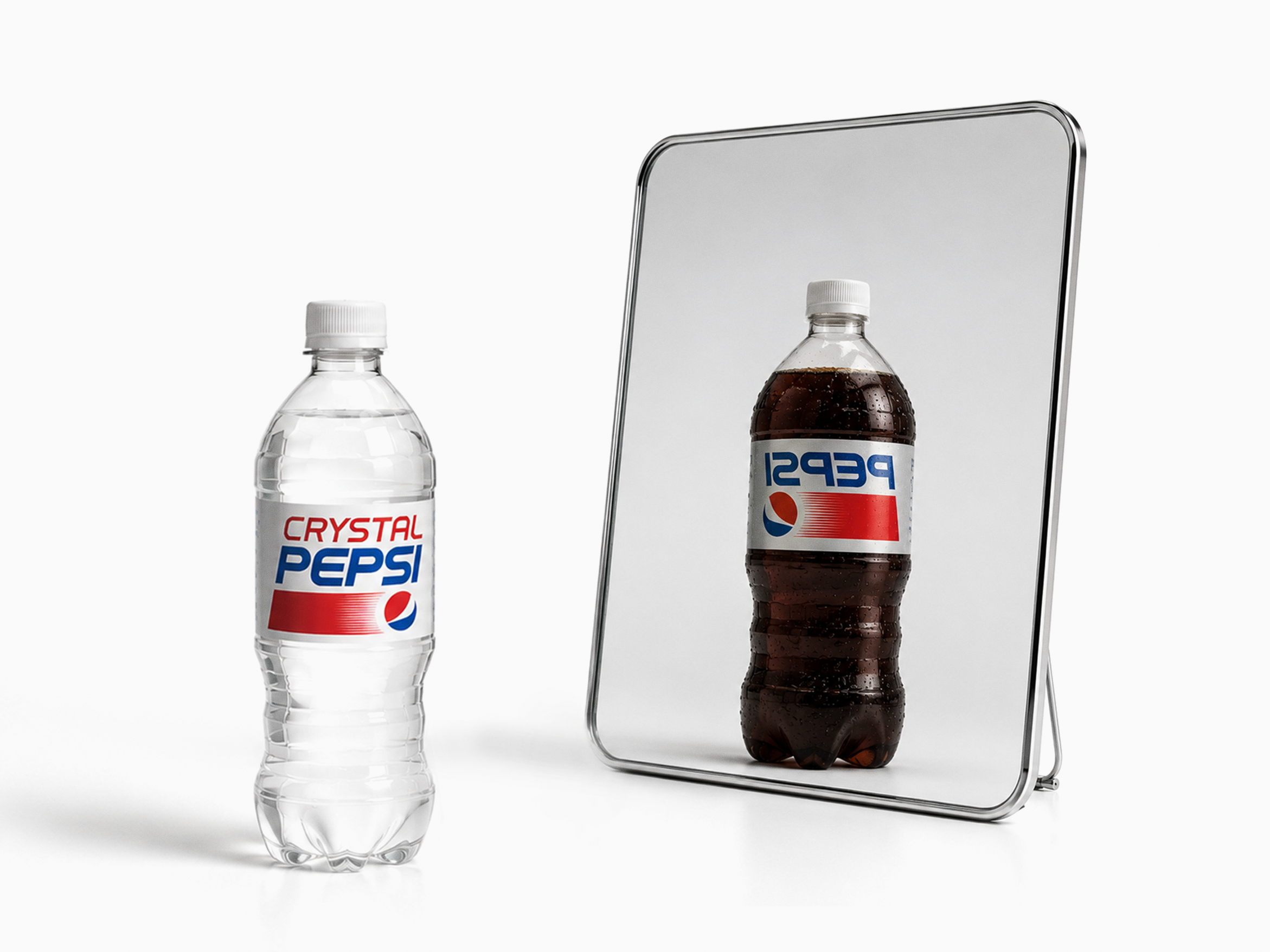
Crystal Pepsi wasn’t trying to create a better cola. It was trying to create a different perception of cola.
Rather than competing on taste, Pepsi attempted to reposition the category by importing the cultural meaning that transparency had already acquired. If consumers increasingly equated clear products with purity and modernity, perhaps those same associations could reshape how they perceived cola.
The strategy wasn’t to invent new meaning.
It was to borrow existing meaning.
The challenge was that borrowed cultural signals only work when they reinforce a brand’s own narrative. Transparency created immediate interest, but the launch still needed to answer why a clear cola deserved to exist beyond the trend that inspired it.
Narrative & Clarity
Few launches have ever communicated their difference as instantly as Crystal Pepsi.
Within seconds, consumers understood exactly what they were looking at: Pepsi, but clear.
What they struggled to understand was why that difference mattered.
The launch answered what the product was far better than why someone should choose it. Transparency became the entire narrative, leaving little room for a stronger explanation of the value it created beyond visual novelty.
Consumers never struggled to describe Crystal Pepsi. They struggled to justify it.
A launch achieves clarity when people can explain not only what has changed, but why that change improves the experience. Crystal Pepsi succeeded at the first question while leaving the second largely unanswered.
Structural Architecture
From an execution standpoint, the launch was exceptionally well constructed.
Pepsi aligned three powerful forces at once: a strong cultural trend, an unmistakably differentiated product, and a coordinated national rollout. Advertising, retail placement, and distribution worked together to maximize discovery, while the product’s appearance became a marketing asset in its own right.
The architecture successfully optimized for attention. Consumers noticed it, talked about it, and tried it.
This wasn’t an execution problem.
The mechanics were highly effective at driving first purchase.
What they didn’t architect was the transition from curiosity to conviction.
Where It Leaked
Crystal Pepsi treated differentiation as if it were positioning.
Being visually different created awareness, but it didn’t establish lasting meaning. Once consumers satisfied their curiosity, the launch had little else to reinforce repeat purchase.
The defining characteristic of the product was its appearance rather than its purpose. Transparency became the story instead of supporting one.
The broader cultural trend supplied attention, but it couldn’t supply belief. While consumers associated clear products with purity, they weren’t given a compelling reason why those associations should fundamentally change their relationship with cola.
The launch optimized for the first purchase. It never architected the second.
Execution polish cannot compensate for structural confusion.
If Re-Architected
Rather than leading with transparency, the launch could have anchored itself around a clearer consumption benefit that transparency merely reinforced.
The rollout also required a second narrative after initial trial — one that transformed curiosity into habit and novelty into preference. Attention had already been earned. The architecture needed to give consumers a reason to return.
Final Assessment
Crystal Pepsi demonstrated how effectively a launch can capture public attention without creating lasting meaning. Awareness introduced the product, but the architecture never established a compelling reason for consumers to keep choosing it. A launch earns attention in a moment. It earns belief over time.
Launch Rating: 6.8 / 10
The strongest trends can create attention.
They cannot create purpose.