
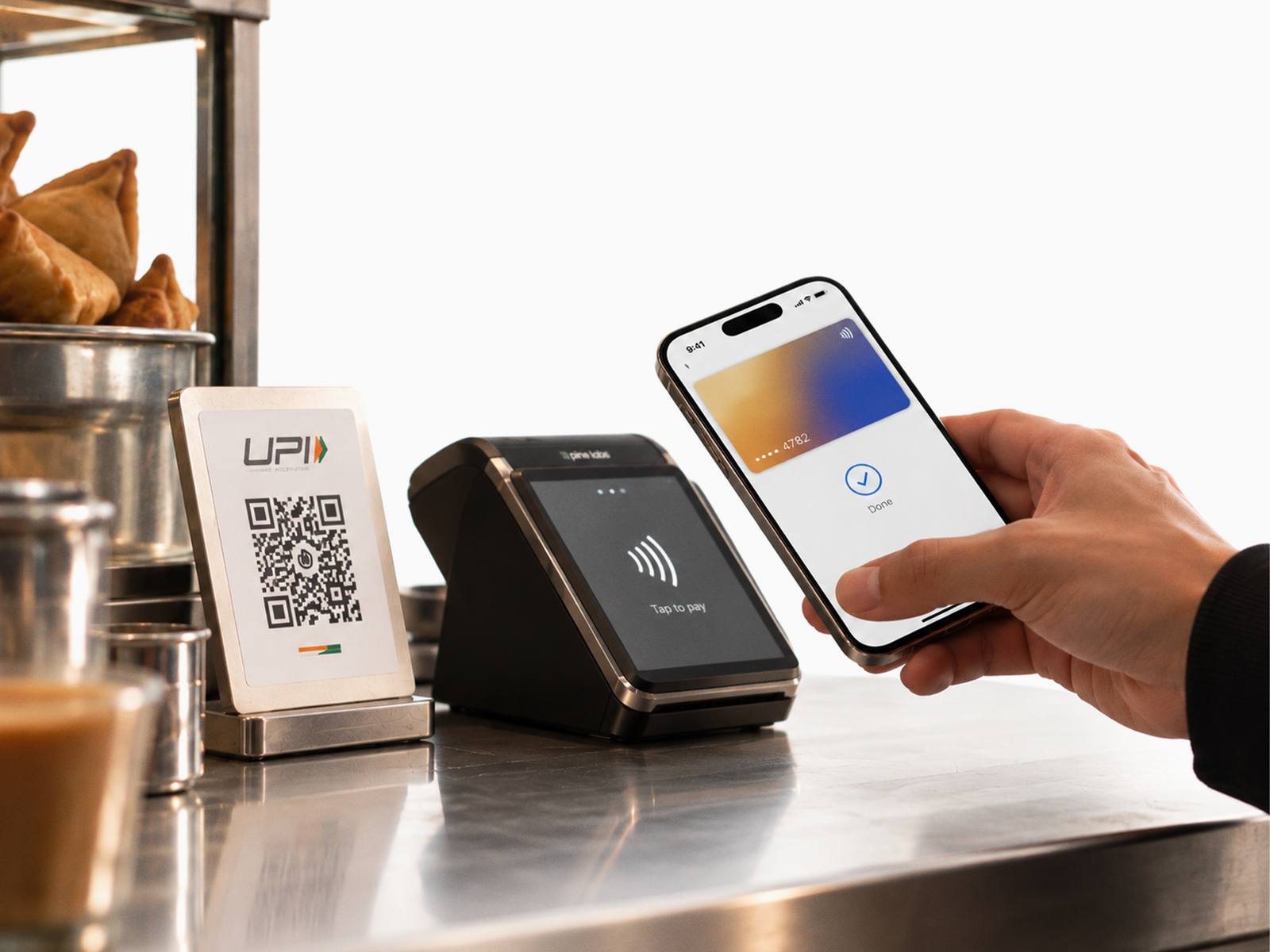
When Apple Pay enters a market that already knows how to pay.
Context
Apple Pay launched in India on September 30, 2026, bringing Apple’s device-native payment system to one of the world’s most mature digital-payment markets.
The launch initially centers on eligible Axis Bank Visa and Mastercard credit cards, with Apple positioning the service around private, secure and frictionless payments across iPhone, Apple Watch, iPad and Mac.
The interesting part is not that Apple finally brought Apple Pay to India.
It is what Apple chose not to do.
It did not attempt to reinvent India’s payment culture. It entered through the behavior Apple already owns: the relationship between the user, their device and their stored identity.
Strategic Intent
The strategic objective is relatively singular:
Make the Apple device a more complete payment interface for Indian users.
That sounds straightforward, but the Indian context makes it more complicated.
Apple isn’t entering a market where digital payments need to be explained. UPI has already normalized instant, mobile-first payments at enormous scale.
So Apple Pay isn’t solving India’s fundamental payment problem.
It is solving an Apple ecosystem problem.
The opportunity is to remove the small points of friction that remain between an Apple user and a card transaction: entering card details, repeatedly entering shipping information, authentication, and carrying a physical card.
This gives the launch a clear strategic position.
Apple Pay does not need to convince India that digital payments are the future.
It needs to convince Apple users that their Apple device should be the payment interface they reach for first.
Narrative & Clarity
This is where the launch is particularly strong.
Apple Pay requires very little explanation.
The proposition essentially becomes:
Add your card to Apple Wallet. Authenticate. Pay.
That compression matters.
There is no complicated new financial product to understand, no new account to create, and no unfamiliar behavioral system to learn. The launch takes something users already understand — paying with a card — and changes the interface through which that action happens.
The strongest part of the narrative is therefore not the advertising.
It is the familiarity of the behavior.
Apple isn’t asking users to adopt Apple Pay as an independent destination. It is embedding the payment behavior into places users already inhabit: their iPhone, Apple Watch, Wallet, Safari and apps.
This also makes Apple’s privacy and security narrative more credible because those claims are connected to visible product mechanics such as device authentication and tokenization rather than existing only as advertising language.
The proposition is consequently easy to perceive:
Your card, without the card.
Structural Architecture
The launch architecture follows a fairly clean sequence.
Tension
Digital payments are already convenient in India.
The tension therefore isn’t “payments are difficult.”
It is that even convenient payments can contain unnecessary steps, while Apple users already carry a device capable of authenticating identity and facilitating the transaction.
Transition
From: carrying and manually using a card.
To: using the Apple device as the payment interface.
That transition is simple enough to understand without extensive explanation.
Promise
Payment becomes more integrated into the Apple ecosystem.
The promise isn’t primarily about adding another payment network.
It is about reducing friction.
Proof
The product experience itself provides much of the proof.
Apple Pay uses Face ID, Touch ID or device authentication, while card information is tokenized rather than simply exposed to merchants.
This is important because the mechanism reinforces the promise.
Mechanism
Apple has assembled the necessary infrastructure through its Wallet, NFC, authentication and merchant/payment-partner ecosystem.
The initial Axis Bank partnership provides the financial entry point, while Apple’s merchant and PSP relationships provide the acceptance layer.
Entry
The entry point is deliberately familiar:
Add an eligible card to Apple Wallet.
The user doesn’t need to learn an entirely new interface.
Reinforcement
Every successful transaction reinforces the same proposition:
I can simply use my Apple device.
That repetition is important because Apple Pay’s value increases through habit rather than through a one-time launch event.
Compounding
This is where the launch becomes more strategically interesting.
If more banks, cards, merchants and apps become compatible, the utility of Apple Pay increases without Apple needing to fundamentally change the proposition.
The system can therefore compound through ecosystem coverage.
The initial launch is not the finished product architecture.
It is the first layer of it.
Where It Leaked
The biggest structural weakness is also obvious.
India already has an extremely efficient payment behavior.
Apple is therefore entering a category where the fundamental job is already well solved.
That means Apple Pay cannot rely on category education to create adoption.
It has to create a preference shift.
There is also an initial coverage constraint. Launching with eligible Axis Bank Visa and Mastercard credit cards creates a clean entry point, but limits the immediate addressable audience.
This creates a dependency:
Apple Pay becomes more valuable as its ecosystem becomes broader.
Until that happens, the experience is compelling primarily to a subset of existing Apple users who also fit the supported-card profile.
The launch therefore has strong architectural coherence, but its immediate reach is narrower than the underlying Apple ecosystem.
The question isn’t whether Apple can make Apple Pay easy.
It clearly can.
The question is whether easy enough is meaningfully better than what Indian consumers already have.
If Re-Architected
The launch itself does not require a dramatic strategic change.
The more important adjustment would be to sharpen the reason for choosing Apple Pay over an already habitual payment method.
The architecture should make the comparative advantage more visible:
not another way to pay, but the payment layer that makes the Apple device more useful.
The second adjustment would be to treat bank and merchant expansion as part of the narrative rather than merely infrastructure.
The broader the acceptance ecosystem becomes, the stronger the behavioral transition becomes.
Apple Pay’s long-term launch story is therefore less about announcing a payment service and more about progressively making the physical card feel unnecessary within the Apple ecosystem.
Final Assessment
Apple Pay’s India launch is structurally strong because it doesn’t fight the market’s existing behavior head-on.
It takes an established Apple behavior — using the device as the interface to everything — and extends it into payments.
The weakness is not in the experience.
It is in the size of the behavioral gap Apple is asking India to cross.
Launch Rating: 8.7 / 10
The strongest launches don’t create entirely new behavior;
They make an existing behavior feel inevitable in a new context.