When the bookstore fits inside the device.
Context
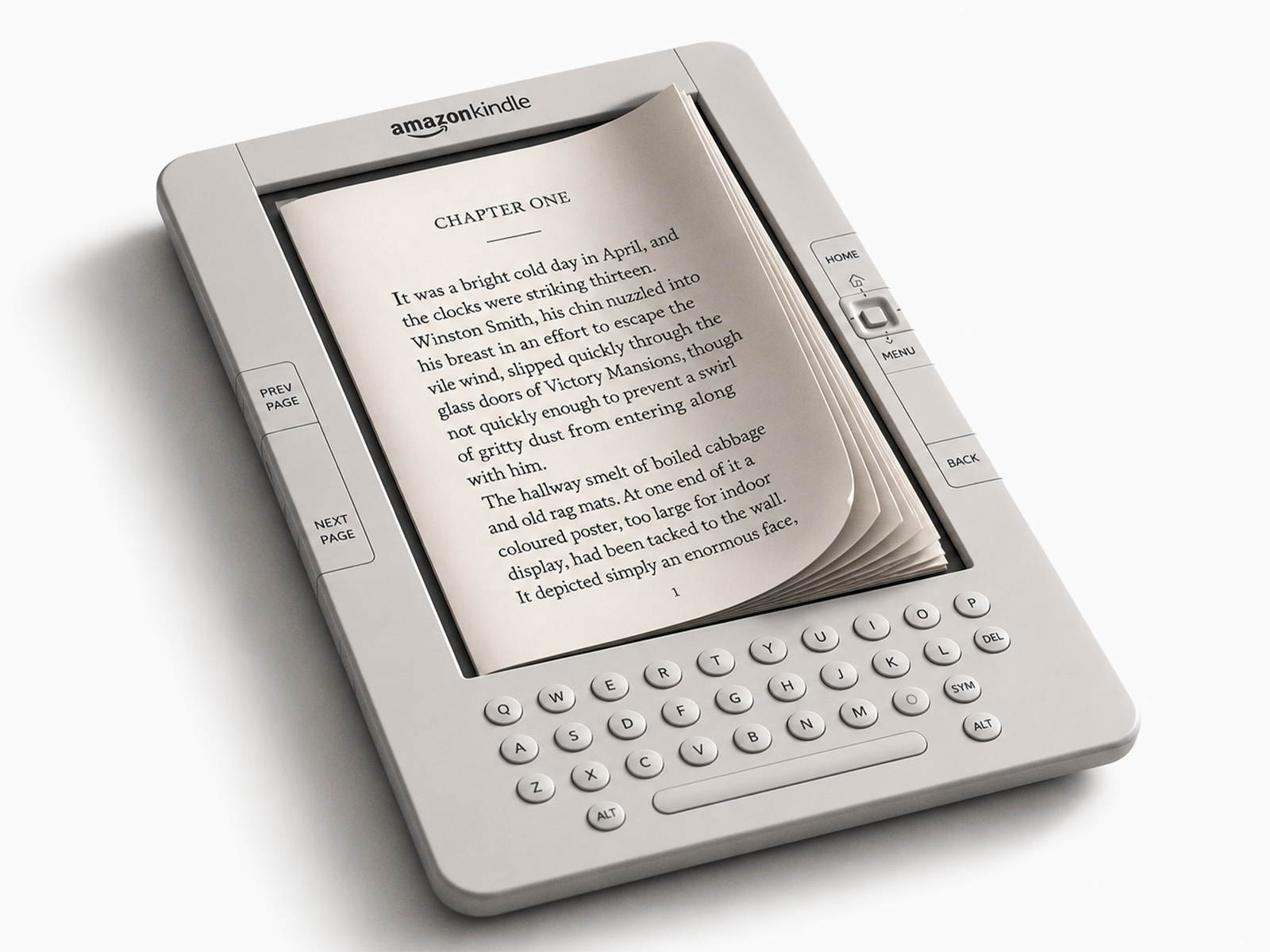
In November 2007, Amazon launched Kindle, a dedicated electronic reading device priced at $399.
At the time, digital reading had an obvious advantage over physical books: digital content could be distributed instantly. But the reading experience still carried much of the friction of digital consumption. Content had to be found, purchased, downloaded, transferred, and then opened on a device that was not necessarily designed for long-form reading.
Amazon’s answer was not simply to build a better screen.
Kindle combined a paper-like electronic display with wireless connectivity and direct access to Amazon’s catalog. At launch, the Kindle Store offered more than 90,000 books, including 101 of 112 current New York Times Best Sellers and New Releases. Books could be purchased directly from the device and downloaded in less than 60 seconds, without a PC or Wi-Fi hotspot.
Jeff Bezos described the top design objective differently: Kindle should “disappear in your hands” so the reader could concentrate on reading. Amazon had spent more than three years developing the device around that objective.
The important launch decision was therefore not putting books on an electronic screen.
It was putting distribution inside the device.
Strategic Intent
The strategic problem Amazon was addressing was larger than the e-reader category.
A physical book had an unusually compressed journey. You could walk into a bookstore, pick up a title, pay for it, and start reading almost immediately.
Digital content had the opposite characteristic. It was easy to reproduce, but the path from wanting something to consuming it could involve several steps.
Kindle attacked that gap.
Amazon’s proposition was effectively:
Think of a book. Buy it. Start reading.
The less-than-60-second promise made this unusually concrete. Amazon wasn’t asking consumers to imagine a distant future of digital publishing. It was demonstrating a shorter path between intent and consumption.
That strategy also aligned closely with Amazon’s existing strengths. Amazon already had the customer account, commerce infrastructure, book catalog, recommendation systems and purchasing behavior. Kindle extended those capabilities into a physical object.
The device became the interface to Amazon’s distribution system.
This is what made the launch strategically different from simply entering consumer electronics.
Amazon wasn’t primarily asking, “How do we make an electronic book?”
It was asking, “How do we make getting a book feel as immediate as reading one?”
Narrative & Clarity
The launch had a remarkably compressed central proposition.
Books in less than 60 seconds.
That statement worked because it translated an unfamiliar technology into a familiar behavior.
Amazon could have led with electronic ink, wireless technology, storage capacity or display resolution. Instead, the strongest message was about what happened after the customer wanted something.
The launch materials repeatedly emphasized the same sequence: Kindle could connect wirelessly to the Kindle Store, allow the customer to purchase a book, and download it without a computer, Wi-Fi hotspot or separate wireless plan.
The technology was therefore subordinated to the outcome.
There was some narrative expansion beyond the core idea. Kindle also supported newspapers, magazines, blogs and personal documents. It included features such as a dictionary, search and annotations. Those features strengthened the overall product, but they weren’t necessary to understand the central launch proposition.
The strongest part of the narrative was simpler:
You want a book. Kindle gets it to you.
That is an unusually efficient value proposition for a product whose underlying technology was relatively unfamiliar in 2007.
Structural Architecture
The most important architectural decision was that Amazon did not treat distribution as something happening around the product.
It made distribution part of the product.
The original Kindle connected four layers:
Amazon’s catalog → Amazon’s commerce system → wireless delivery → reading device
The customer didn’t need to leave the reading environment to complete the transaction.
That mattered because every traditional distribution step Amazon removed made the device more useful.
No computer.
No syncing.
No hunting for Wi-Fi.
No separate wireless plan.
The customer could buy directly from the device and receive the book wirelessly. Amazon covered the wireless connectivity rather than passing a monthly data subscription onto the customer.
The launch also wasn’t designed to end on November 19.
Amazon introduced its Digital Text Platform, the predecessor to Kindle Direct Publishing, on the same day. That created another side of the system: Kindle wasn’t only a new way for readers to consume books; it was also beginning to create a new route for authors and publishers to reach those readers.
That gives the launch a particularly strong flywheel:
More access → more reading → more demand → more content → more reasons to own the device.
The launch moment established the device.
The architecture was designed to make the device increasingly useful afterward.
Where It Leaked
The architecture was strong, but it wasn’t frictionless everywhere.
The first leak was the hardware price.
At $399, Kindle asked customers to make a substantial upfront commitment before experiencing the convenience Amazon was promising. The distribution experience was compressed, but the purchase decision itself was not.
The second was audience breadth.
The core use case was clear: reading books, but Amazon also positioned Kindle around newspapers, magazines, blogs and other content. That expanded the addressable use case, but it slightly diluted the purity of the central narrative.
The third was the inherent tension between digital distribution and physical reading.
Amazon could make acquiring a book almost instantaneous, but it still had to convince readers that an electronic device could replace enough of the physical-book experience to justify the transition. The team had spent years working on electronic paper precisely because digital reading itself was still a problem to solve.
So the launch successfully collapsed the distance between wanting and getting a book.
It could not completely eliminate the distance between digital and physical reading.
That distinction matters.
If Re-Architected
The launch could have made the distribution transformation even more dominant in its communication.
Rather than giving equal narrative weight to the breadth of Kindle’s features, the story could have been organized around the simple journey from wanting a book to reading it:
Want → search → buy → read
becoming:
Want → read.
The second adjustment would be reducing the friction at the point of entry. At $399, the customer had to make a substantial hardware commitment before experiencing the convenience of Kindle’s distribution model. A lower-friction entry point could have made the core advantage easier to adopt.
These would be refinements rather than fundamental changes. The underlying architecture- device, catalog, commerce and wireless delivery- was already tightly connected.
Final Assessment
Kindle’s launch is significant because Amazon understood that the problem with digital books wasn’t simply the screen.
It was the distance between desire and access.
Amazon compressed that distance by embedding the distribution system into the reading device itself. The Kindle Store, Amazon account, wireless connectivity and physical reader became one continuous experience.
The device was the visible product.
Distribution was the real innovation.
Launch Rating: 9.0 / 10
The strongest launches don’t always create a new behavior;
Sometimes they remove everything standing between an existing desire and its fulfillment.