When Convenience Became the Complexity
Context
In March 2016, Juicero launched in California with a proposition that sounded familiar but was packaged very differently: fresh, cold-pressed juice at home, without the preparation or cleanup normally associated with juicing.
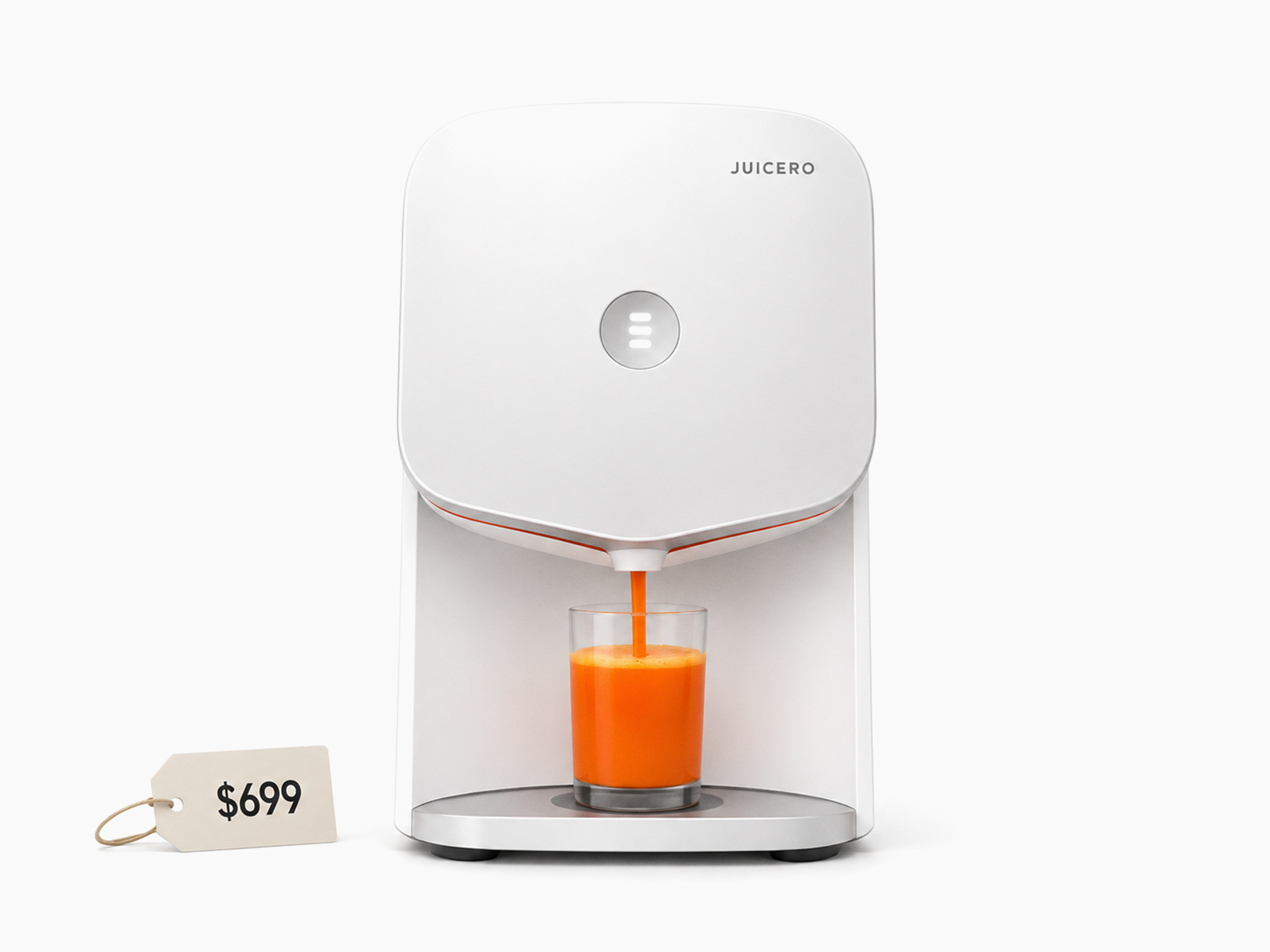
Founded by Doug Evans, formerly of Organic Avenue, Juicero had spent years developing a connected countertop press. The system consisted of three parts: the $699 Juicero Press, proprietary packs containing pre-washed and chopped organic produce, and an app that handled setup, pack information, inventory and subscriptions.
The launch arrived with significant financial backing. Juicero announced a $70 million Series B alongside the product launch, bringing its reported funding to roughly $120 million. The machine was initially available only in California, while the produce packs cost roughly $4–$10 each and were sold through subscription rather than ordinary grocery channels.
The ambition was bigger than selling another juicer. Evans described the problem as the work involved in making fresh juice at home: preparation, pressing and cleanup. Juicero was designed to turn that process into a one-touch experience.
The launch, however, immediately exposed a tension between the simplicity of the experience and the complexity required to deliver it.
Strategic Intent
Juicero’s strategic objective was relatively clear: make fresh juice convenient enough to become an everyday habit.
That was a legitimate problem to solve.
Traditional juicing required buying produce, preparing it, operating a cumbersome machine and cleaning it afterward. Juicero compressed that entire process into placing a prepared pack into a machine and pressing a button. Contemporary coverage repeatedly described the product as a “Keurig for juice,” an analogy that captured the intended behavioral shift: move preparation upstream and make consumption nearly effortless.
There was also a broader platform strategy underneath it.
The packs created recurring purchases. QR codes connected the physical product to the machine and app. The app could provide nutritional information, track inventory and facilitate future deliveries.
That created an attractive business architecture:
Machine → Packs → Subscription → Repeat consumption
The strategic problem wasn’t that this system lacked logic.
It was that Juicero had to make consumers value every layer of the system.
The juice was the desired outcome. The machine, packs, software and subscription were the infrastructure required to get there.
That distinction would become central to the launch.
Narrative & Clarity
Juicero was unusually easy to understand.
Put a pack into the machine.
Press a button.
Get fresh juice.
The launch materials communicated the physical experience clearly. Vogue’s launch coverage, for example, demonstrated the process almost immediately: select a refrigerated pouch, insert it, and watch the machine produce the juice.
The problem was not product comprehension.
It was value comprehension.
At $699, Juicero was asking consumers to understand why an appliance was necessary for a process that, at its most basic level, was simply extracting juice from prepared produce.
The launch therefore had two propositions operating simultaneously.
Functional proposition:
We make fresh juice effortless.
Economic proposition:
This effortless experience is worth $699 plus recurring purchases of proprietary packs.
The first was immediately legible.
The second required considerably more persuasion.
Contemporary coverage noticed the problem without needing the later controversy. BevNET explicitly called the proposition expensive while noting that cheaper and more convenient cold-pressed juice alternatives already existed. The Christian Science Monitor similarly reported the $699 machine and $5–$10 packs while questioning who would actually buy it.
This is where the launch’s value architecture began to leak.
Juicero made the experience simpler, but the explanation for why the system deserved to exist became harder.
Structural Architecture
The architecture itself was sophisticated.
The Press created the physical ritual.
The Packs controlled the ingredients.
The App connected the system.
The subscription created recurring demand.
The QR codes introduced traceability, freshness information and a digital relationship with the customer.
From a business-design perspective, this was deliberate.
Juicero wasn’t trying to sell a juicer once. It was trying to create a closed ecosystem around fresh juice.
That distinction is important.
A conventional juicer sells hardware.
Juicero attempted to sell a recurring fresh-juice service accessed through hardware.
The launch moment reinforced this architecture through a combination of founder visibility, substantial funding news and extensive technology coverage. The March 31 launch simultaneously introduced the product and announced the $70 million Series B, creating a significant media event around the company’s arrival.
But the architecture also created multiple points of friction.
A consumer couldn’t simply buy produce and use the machine.
They needed:
$699 Press → proprietary packs → subscription → delivery → machine → juice.
Every additional layer was defensible from the company’s perspective.
But every additional layer also had to be justified from the customer’s perspective.
This is the fundamental architectural mismatch.
Juicero optimized the process of making juice while simultaneously making the system required to make juice unusually elaborate.
Where It Leaked
The first leak was value-to-cost compression.
The launch was asking consumers to pay a premium not simply for better juice, but for the removal of preparation and cleanup.
That can work. Premium convenience is a proven category.
But the premium has to feel proportional to the problem.
Juicero’s $699 entry point made that calculation unusually visible. Contemporary launch coverage immediately framed the price as the central question. Fortune called the price “eye-popping” while noting that each eight-ounce serving cost another $4–$10.
The second leak was system dependency.
Juicero did not merely simplify the juicing process. It replaced an open-ended activity with a proprietary ecosystem.
The customer couldn’t simply bring their own produce into the system. The machine was designed around Juicero’s packs, which were distributed through its own subscription model.
That created recurring revenue for the company, but also recurring commitment for the consumer.
The third leak was technology without proportional necessity.
Wi-Fi connectivity, QR codes, nutritional information and freshness tracking made the product feel like a modern platform rather than a conventional kitchen appliance.
But the technology didn’t fundamentally change the customer’s desired outcome.
The customer wanted juice.
The architecture increasingly asked them to appreciate the infrastructure surrounding the juice.
That is where the launch became vulnerable.
When infrastructure becomes more visible than the value it enables, the architecture starts explaining itself instead of the product.
And crucially, none of this requires hindsight.
The tension was visible on launch day.
A $699 machine.
A recurring supply of proprietary packs.
A subscription.
A connected appliance.
A restricted initial market.
All to solve a fundamentally simple consumer job.
If Re-Architected
The first adjustment would be to make the juice, not the machine, the primary product.
The consumer-facing proposition should have been built around a recurring fresh-juice service, with the Press positioned as the mechanism that made that service superior, not as the hero of the proposition.
The second adjustment would be to reduce the initial commitment.
The launch needed a way for consumers to experience the value before committing to the full ecosystem. A lower-friction entry mechanism—sampling, retail availability, restaurant partnerships or a significantly lower hardware barrier—could have allowed Juicero to establish the habit before asking consumers to adopt the infrastructure.
The underlying insight was sound:
Fresh juice becomes more valuable when the work disappears.
The mistake was making the infrastructure required to remove that work so prominent.
Final Assessment
Juicero’s launch was not unclear. It was not technologically unserious. And it wasn’t missing a coherent business model.
Its weakness was more structural.
The company built an impressive architecture around a consumer benefit that was much simpler than the architecture itself.
The launch asked consumers to pay for convenience, but made the machinery of that convenience impossible to ignore.
Juicero demonstrates that removing friction from the experience is only valuable when the architecture required to remove it doesn’t become the new friction.
Launch Rating: 5.3 / 10
The best solutions don’t merely remove friction.
They know which friction is worth removing.