
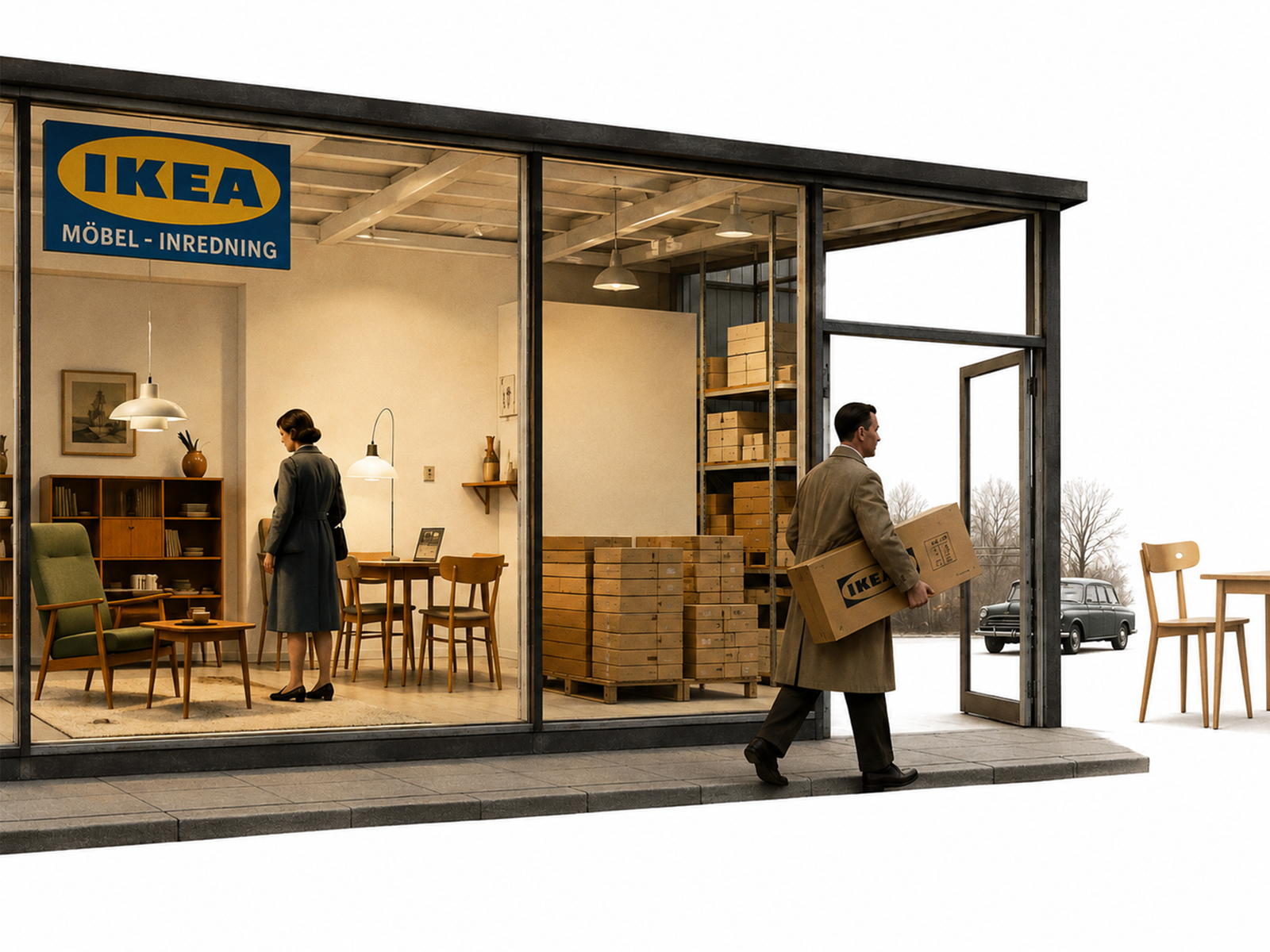
When customers became part of the distribution
Context
IKEA was founded by Ingvar Kamprad in Sweden in 1943, but the launch of the IKEA concept happened much later.
By the early 1950s, IKEA was selling furniture through its catalogue. The proposition was simple: functional, well-designed furniture at prices accessible to a much larger audience. But the model created an immediate problem. Customers questioned whether furniture could really be both inexpensive and well-made.
IKEA responded by opening a permanent showroom in Älmhult in 1953. Customers could see, touch and experience the furniture before ordering it. Then another problem emerged. Large furniture was expensive to transport and vulnerable to damage during delivery.
In 1956, IKEA began experimenting with flat-packed furniture and self-assembly. By the time the first IKEA store opened in Älmhult in 1958, these individual solutions had become one connected retail experience.
The launch was not simply a new furniture store.
It was a new way of asking customers to buy furniture.
Strategic Intent
IKEA’s objective was not simply to sell furniture more cheaply.
It was to make good furniture accessible to more people by changing the economics of how furniture was sold and distributed.
That required IKEA to rethink several assumptions at once.
A traditional furniture retailer could show the product, sell it and arrange delivery. IKEA increasingly asked the customer to participate in those steps.
The customer would visit the store.
The customer would explore the furniture.
The customer would select the product.
The customer would take it home.
The customer would assemble it.
Each behavior supported the underlying price proposition.
This is what made the 1958 launch strategically interesting. IKEA was not launching a campaign and then asking customers to adapt to the product.
It was launching a system in which the customer’s behavior was part of the system itself.
The business model and the customer experience were being designed together.
Narrative & Clarity
The core proposition was easy to understand:
Good design and function at a price more people can afford.
But the launch did something more useful than simply communicating that proposition.
It demonstrated it.
The first store used home-like room settings so customers could experience furniture in context rather than evaluating individual products in isolation. Furniture was available in flat packs that customers could take home themselves.
The result was a customer journey that required relatively little explanation:
See it → choose it → take it home → assemble it.
The store became the communication.
That matters because IKEA was asking customers to accept behavior that traditional furniture retail did not necessarily require from them.
Instead of hiding the tradeoff, IKEA built the tradeoff into the experience.
The lower price was connected to visible customer participation.
That made the proposition easier to understand because customers could see the system behind the price.
Structural Architecture
The strength of the launch was the way its components reinforced one another.
The catalogue created reach.
The showroom created trust.
The room displays demonstrated the product.
The flat-pack format reduced the physical burden of transportation.
Self-assembly transferred part of the final production process to the customer.
The store connected all of these behaviors into one physical journey.
The 1958 Älmhult store was explicitly conceived as a combination of catalogue mail order and showroom retail. It gave customers an environment in which they could experience the products and then take selected furniture home.
That created an unusually coherent launch architecture.
The customer did not need to be convinced through a complicated advertising argument.
The environment explained the model.
The furniture explained the price.
The customer’s own actions completed the transaction.
This also gave the launch something campaigns often struggle to create: repeatability.
The store was not just a place where IKEA happened.
It was a physical template for how IKEA could operate.
The launch therefore had two layers.
At the surface was a new furniture retail experience.
Underneath was a new distribution mechanism.
That second layer is what gave the launch its structural strength.
Where It Leaked
The main weakness is that this was not a modern launch in the conventional sense.
There was no concentrated campaign moment designed to create a sudden burst of attention. The IKEA concept had developed progressively through the catalogue, showroom and flat-pack innovations before arriving at the 1958 store.
That makes the launch less powerful if judged purely on launch-day mechanics.
There was also limited urgency.
The customer had a clear commercial action, but there was no obvious limited window, drop mechanic or highly concentrated call to action.
The launch depended more on physical experience than on creating a short-lived attention event.
There is another structural tradeoff.
The same customer participation that helped IKEA reduce costs also created additional work for the buyer.
Transportation and assembly were no longer entirely the retailer’s responsibility.
That model works when the customer understands the exchange.
Lower price in return for greater participation.
But without that clarity, the same mechanism can feel like the customer is simply doing work that the retailer chose not to do.
IKEA’s architecture was therefore strong because the tradeoff was embedded in the proposition, not because the tradeoff disappeared.
If Re-Architected
The IKEA launch architecture was already structurally strong. The main opportunity would be to make the customer exchange more explicit at the point of launch.
The proposition could be compressed into a simple demonstration:
Here is the furniture. Here is the price. Here is what IKEA asks the customer to do. Here is why that makes the price possible.
That would make the relationship between customer participation and affordability immediately visible.
A second adjustment would be to frame self-service, transportation and assembly as deliberate components of the experience rather than secondary inconveniences.
The customer is not simply receiving less service.
The customer is participating in a system designed to produce a lower price.
Making that exchange explicit would strengthen the launch narrative without changing the underlying architecture.
Final Assessment
IKEA’s 1958 launch was not powerful because it introduced a radically different piece of furniture.
It was powerful because it introduced a radically different relationship between the retailer and the customer.
The customer was no longer simply the person who received the finished product.
The customer became part of the journey that made the product affordable.
That is the deeper launch lesson.
IKEA did not just launch a new way to sell furniture. It launched a system in which the customer helped make the promise possible.
Launch Rating: 9.1 / 10
The best systems do not simply serve customers.
They design a role for them.