
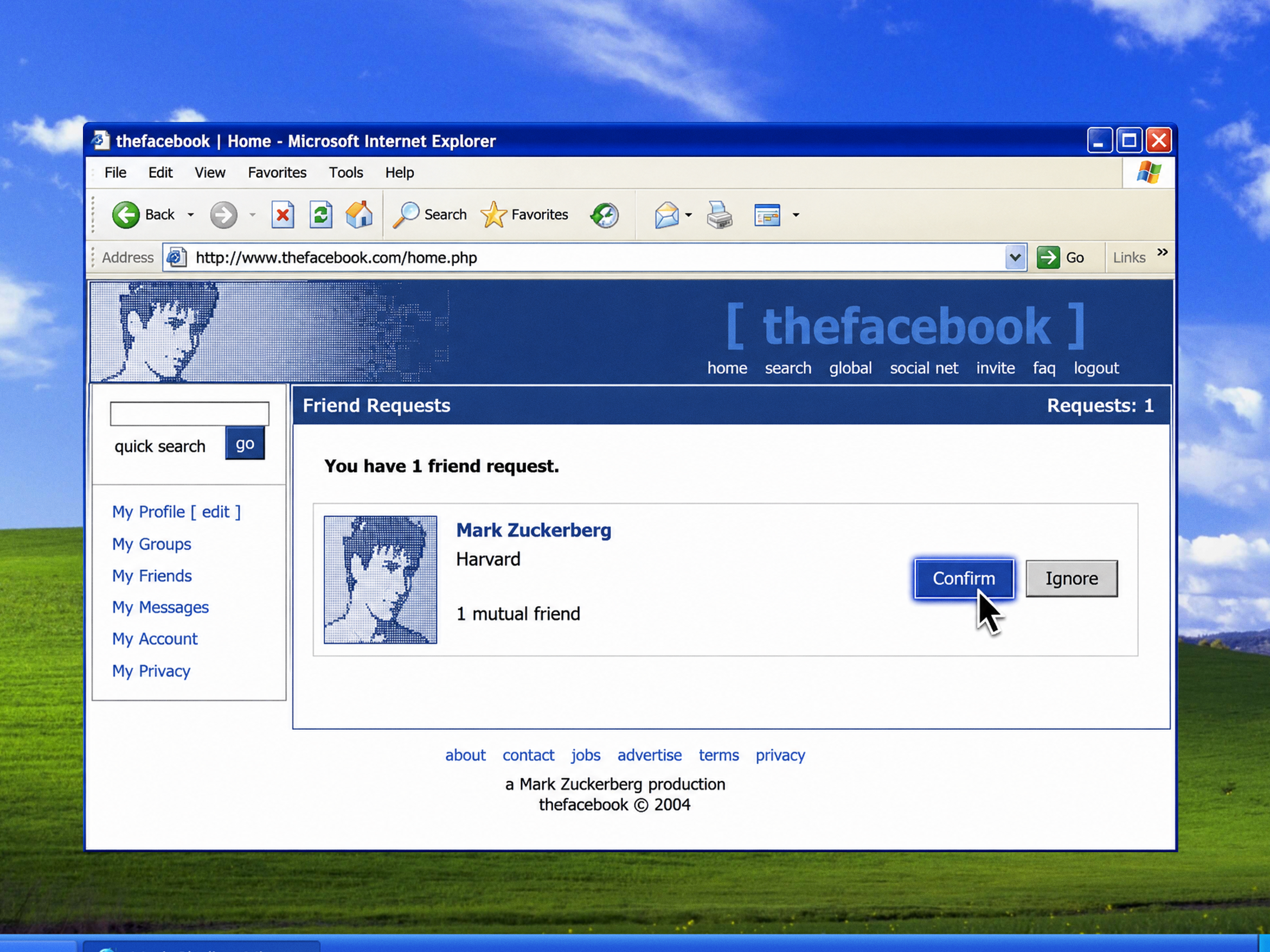
When the network became valuable before it became massive.
Context
In 2004, Facebook launched initially as “TheFacebook,” restricted to Harvard students before gradually expanding to other universities and eventually the public.
At the time, social networking was already gaining traction online. Platforms like Friendster and Myspace had proven that digital identity and online social interaction could scale rapidly. But most platforms in the category are optimized primarily for openness and audience growth.
Facebook approached the category differently.
The launch was not designed around immediate mass adoption. It was designed around concentrated social density. Access restriction itself became part of the product architecture.
The early environment carried built-in trust:
- Real identities
- Shared institutions
- Existing peer relationships
- High contextual overlap
That changed user behavior immediately.
Strategic Intent
Facebook’s launch objective was structurally precise:
Establish the dominant real-identity network inside university ecosystems before expanding outward.
This was not merely demographic targeting. The university restriction model created controlled network clusters where engagement quality was naturally higher.
Every new user entered an environment that already possessed offline context:
- They knew people
- People knew them
- Reputation already existed
- Social validation was inherited from the real world
This dramatically reduced trust friction compared to open social platforms.
More importantly, Facebook avoided one of the most common structural mistakes in network products:
premature scale expansion before behavioral habits stabilize.
Instead of maximizing user acquisition immediately, Facebook deepened interaction density inside concentrated ecosystems first.
The launch was optimized for retention and engagement quality before global reach.
Narrative & Clarity
The product narrative was immediately understandable:
A real-identity online network for your college community.
That clarity mattered.
Facebook did not require users to learn new online behavior patterns. It digitized an already existing social environment.
The positioning was also highly compressed:
- Exclusive
- University-specific
- Real identity
- Socially validated
The exclusivity itself became narrative infrastructure.
Access restriction generated signaling value:
membership implied belonging to a defined social ecosystem.
This created a strong organic pull without relying on aggressive marketing or broad awareness campaigns.
The launch also benefited from unusually clean positioning relative to competitors. Real-name culture and institutional email verification created a more credible social environment than many open social platforms of the era.
The product felt structured rather than chaotic.
Structural Architecture
The rollout sequencing was Facebook’s defining architectural strength.
The platform expanded through controlled concentric layers:
- Harvard
- Ivy League campuses
- Major universities
- Wider academic networks
- Public rollout
Each expansion phase inherited credibility from the previous one.
This created compounding social proof instead of fragmented audience acquisition.
The launch mechanics were exceptionally efficient:
- Institutional email verification
- Closed-network onboarding
- Existing offline identity mapping
- Organic invitation dynamics
- Dense interaction loops
Facebook also embedded itself into high-frequency student behavior early:
- Relationship signaling
- Social monitoring
- Campus awareness
- Event coordination
- Peer visibility
The platform became habitual before it became universal.
Founder visibility played a secondary but supportive role. Mark Zuckerberg was positioned more as a technical builder than a public-facing celebrity founder during the early phase, which aligned with the product’s functional identity.
Most importantly, Facebook delayed mass accessibility long enough to stabilize behavioral infrastructure first.
That restraint became the advantage.
Many network products attempt scale before interaction quality compounds. Facebook reversed the order.
Where It Leaked
The launch architecture was exceptionally strong, but not without structural limitations.
The exclusivity model created high engagement density inside universities, but expansion beyond campuses introduced contextual dilution risk.
What worked naturally inside tightly connected academic environments became harder to sustain at an internet scale. As Facebook expanded globally, the original trust layer weakened and increasingly required algorithmic systems and engagement infrastructure to replace the social coherence universities had previously provided.
The launch was also highly dependent on institutional clustering. Replicating the same interaction intensity across broader demographics required substantially more behavioral engineering.
Another limitation:
the original positioning clarity was strongest for students.
As Facebook evolved into a universal social platform, the narrative inevitably became broader and less structurally sharp than its early identity system.
If Re-Architected
- Facebook could have introduced a stronger segmentation architecture during public expansion to preserve contextual identity coherence beyond university environments.
- Transitional onboarding systems for non-student demographics may have reduced dilution during the shift from campus network to universal platform.
Final Assessment
Facebook’s launch succeeded because it prioritized interaction quality before audience scale. The platform strengthened trust density first, then expanded distribution around it.
In network products, premature openness often weakens behavior before habits stabilize. Facebook understood the sequencing better than almost anyone else.
Launch Rating: 9.3 / 10
The architecture of trust preceded the architecture of scale.