
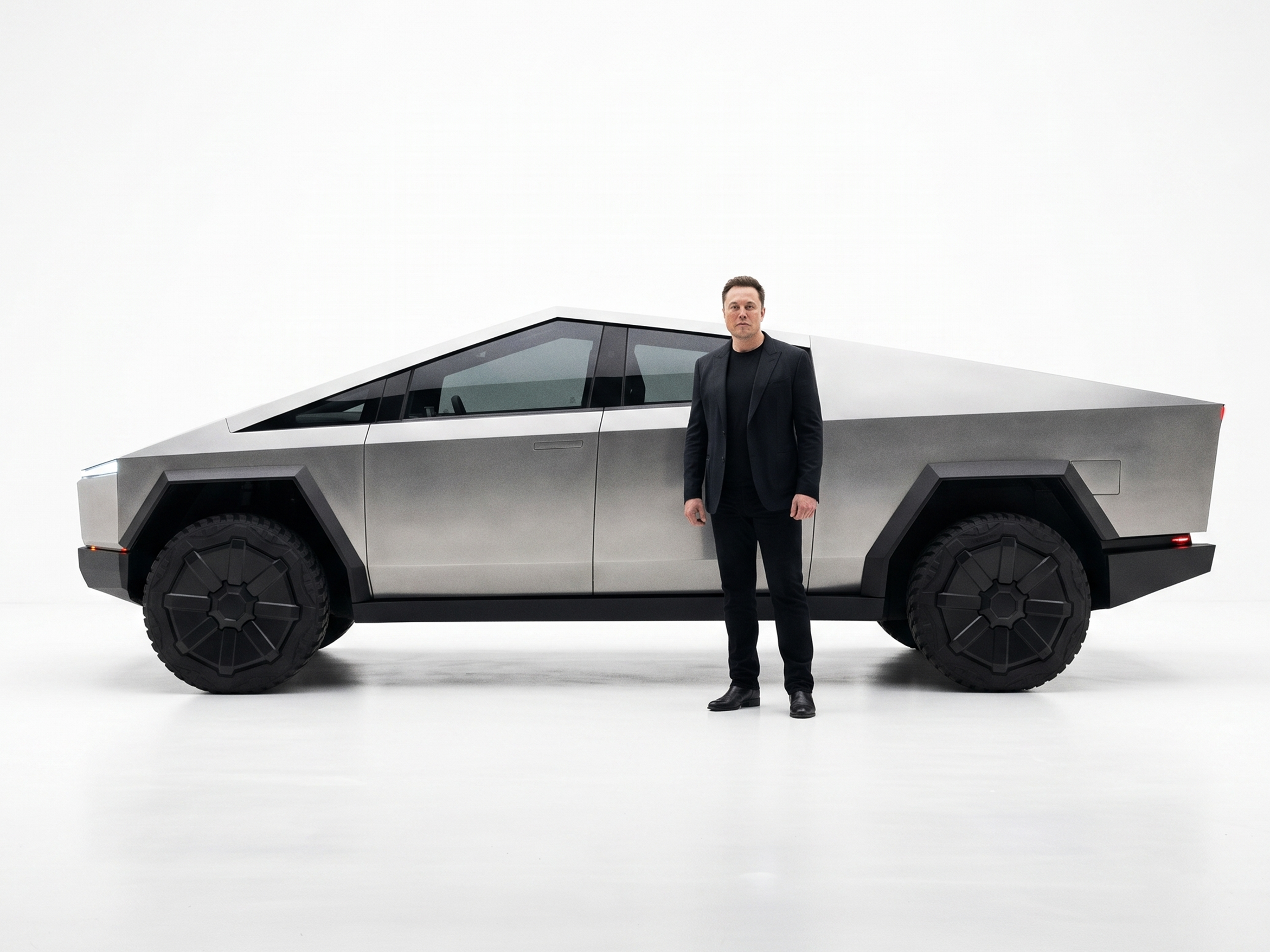
When convention is abandoned, differentiation becomes inevitable.
Context
When Tesla unveiled the Cybertruck in 2019, it immediately became one of the most polarizing products the automotive industry had seen. Rather than refining the familiar pickup truck formula, Tesla introduced a stainless-steel, angular vehicle that appeared closer to science fiction than contemporary automotive design. Four years later, on November 30, 2023, the company finally began customer deliveries at Gigafactory Texas.
The ambition was never simply to enter the pickup market. Tesla was attempting to redefine what a pickup could represent in an electric future. While most manufacturers were translating existing truck conventions into EVs, Tesla questioned the convention itself.
The launch also carried unusual weight. Years of production delays had amplified public scrutiny, raised expectations, and turned the Cybertruck into one of the industry’s longest anticipated consumer products. By delivery day, the conversation had extended far beyond automotive enthusiasts into mainstream culture.
Strategic Intent
The Cybertruck launch pursued a remarkably singular objective: position Tesla as the company willing to reinvent categories rather than compete within them.
Every visible decision reinforced that objective. The geometric exterior, stainless-steel exoskeleton, ballistic demonstrations, and unconventional engineering all communicated that this was not another electric truck competing on incremental improvements. It was presented as an entirely different interpretation of utility.
Importantly, Tesla never attempted to appeal to everyone immediately. The launch was designed for believers before pragmatists. Early adopters, technology enthusiasts, and Tesla loyalists became the initial audience, with broader market adoption positioned as a consequence rather than the objective.
This strategic discipline prevented the launch from diluting its identity in pursuit of mass acceptance.
Narrative & Clarity
Despite its visual controversy, the Cybertruck communicated a surprisingly simple narrative.
The toughest truck, rebuilt for the electric age.
Consumers did not need lengthy explanations to understand that the vehicle represented something fundamentally different. Whether people admired or rejected the design, they understood its purpose almost instantly.
That clarity extended beyond aesthetics. Tesla consistently framed durability, utility, performance, and engineering as one integrated story rather than a collection of isolated specifications.
The launch also benefited from founder consistency. Elon Musk had spent years publicly advocating first-principles engineering and questioning industry assumptions. The Cybertruck became a physical manifestation of that philosophy.
Few launches achieve this level of narrative compression. The product itself carried much of the storytelling.
Structural Architecture
The delivery event demonstrated a high degree of launch architecture rather than simple product presentation.
Tesla concentrated years of anticipation into a single, clearly defined public moment. Customer deliveries took place at Gigafactory Texas, livestreamed globally, transforming manufacturing progress into a shared cultural event instead of a routine product release.
Founder visibility remained central throughout the rollout. Rather than separating leadership from product communication, Elon Musk continued serving as the primary narrative anchor, maintaining consistency between Tesla’s long-term vision and the launch itself.
The years of production delays also produced an unusual structural effect. While delays often erode momentum, Tesla’s existing brand equity and sustained public conversation allowed anticipation to accumulate instead of dissipate. Every prototype sighting, engineering update, and manufacturing milestone reinforced the launch narrative long before deliveries began.
Media coverage extended naturally across automotive publications, technology outlets, social media, YouTube creators, and mainstream news. Much of this amplification occurred organically because the product itself generated discussion without requiring aggressive promotional campaigns.
The result was a launch that felt coordinated across product, founder, manufacturing, and public attention.
Where It Leaked
The Cybertruck’s primary structural weakness emerged after the launch moment itself.
Demand dramatically exceeded Tesla’s immediate production capacity. While reservations had accumulated for years, actual deliveries remained limited during the initial rollout. This created a disconnect between public excitement and widespread product availability.
The launch also relied heavily on Tesla’s ability to generate organic conversation. Unlike many consumer product launches, relatively little observable public evidence suggests a deliberately structured post-launch activation strategy extending beyond deliveries and ongoing media attention.
In other words, Tesla engineered an exceptional launch moment but depended largely on the product’s inherent visibility to sustain momentum afterward.
Fortunately for Tesla, the Cybertruck itself proved capable of carrying that burden.
If Re-Architected
The post-launch phase could have benefited from a more visible momentum architecture built around progressive capability releases, customer stories, and staged adoption milestones during the production ramp.
Greater transparency around production timelines and availability could also have reduced the gap between unprecedented attention and limited early delivery volume without weakening anticipation.
Final Assessment
The Cybertruck demonstrates that great launch architecture is not about universal approval.
Many people disliked its appearance. Others questioned its practicality. Yet almost everyone understood what Tesla was trying to change.
That distinction matters.
Tesla’s greatest achievement was not designing an unconventional truck; it was making that unconventionality feel inevitable within its broader brand narrative.
Launch Rating: 9.0 / 10
The strongest launches do not optimize for consensus.
They optimize for unmistakable positioning.