When marketing becomes social behavior.
Context
When Warner Bros. and Mattel released Barbie on July 21, 2023, they were launching more than a summer blockbuster. The film became the first major test of Mattel’s strategy to transform its toy portfolio into a long-term entertainment business.
The opportunity was significant, but so was the challenge. Barbie was one of the world’s most recognizable brands, yet decades of cultural debate had changed how people viewed the character. For some, Barbie represented childhood nostalgia. For others, she symbolized unrealistic beauty standards and outdated ideals.
The launch had to embrace both realities without becoming trapped by either. Instead of asking audiences to reconsider Barbie, it made Barbie impossible to ignore.
Strategic Intent
The objective extended well beyond opening weekend.
Warner Bros. needed a successful theatrical release. Mattel needed something much larger. The company wanted to prove that its intellectual property could evolve beyond the toy aisle into a sustainable entertainment ecosystem.
That required a launch that appealed to multiple generations at once. Older audiences needed to reconnect with a brand they grew up with. Younger audiences needed a reason to care about Barbie for the first time.
The campaign solved this by changing the conversation. Rather than treating Barbie as a perfect icon, it presented her as a self-aware cultural figure capable of laughing at her own legacy. That decision gave the brand permission to participate in modern conversations without abandoning its identity.
Every major activation reinforced this singular objective.
Narrative & Clarity
The campaign achieved something few launches manage.
Everyone knew what was being launched.
Very few people knew exactly what to expect.
The visual system did most of the work. The unmistakable pink palette, Dreamhouse imagery and Margot Robbie’s portrayal made the campaign instantly recognizable. Even a single image was enough to identify the film.
The story itself remained deliberately vague.
Was it a comedy?
A satire?
A film for children?
A film for adults?
The campaign resisted answering those questions directly. Instead, it allowed curiosity to become part of the experience. Audiences understood the brand immediately while discovering the narrative gradually.
That ambiguity created anticipation, although it also prevented complete clarity about the film’s emotional proposition.
Structural Architecture
This was one of the most coordinated launch systems in recent entertainment history.
Traditional marketing established awareness through trailers, interviews, premieres and press appearances. Around that foundation, Warner Bros. and Mattel built an ecosystem of hundreds of brand collaborations spanning fashion, beauty, food, hospitality and consumer products.
The objective was not simply reach.
It was saturation.
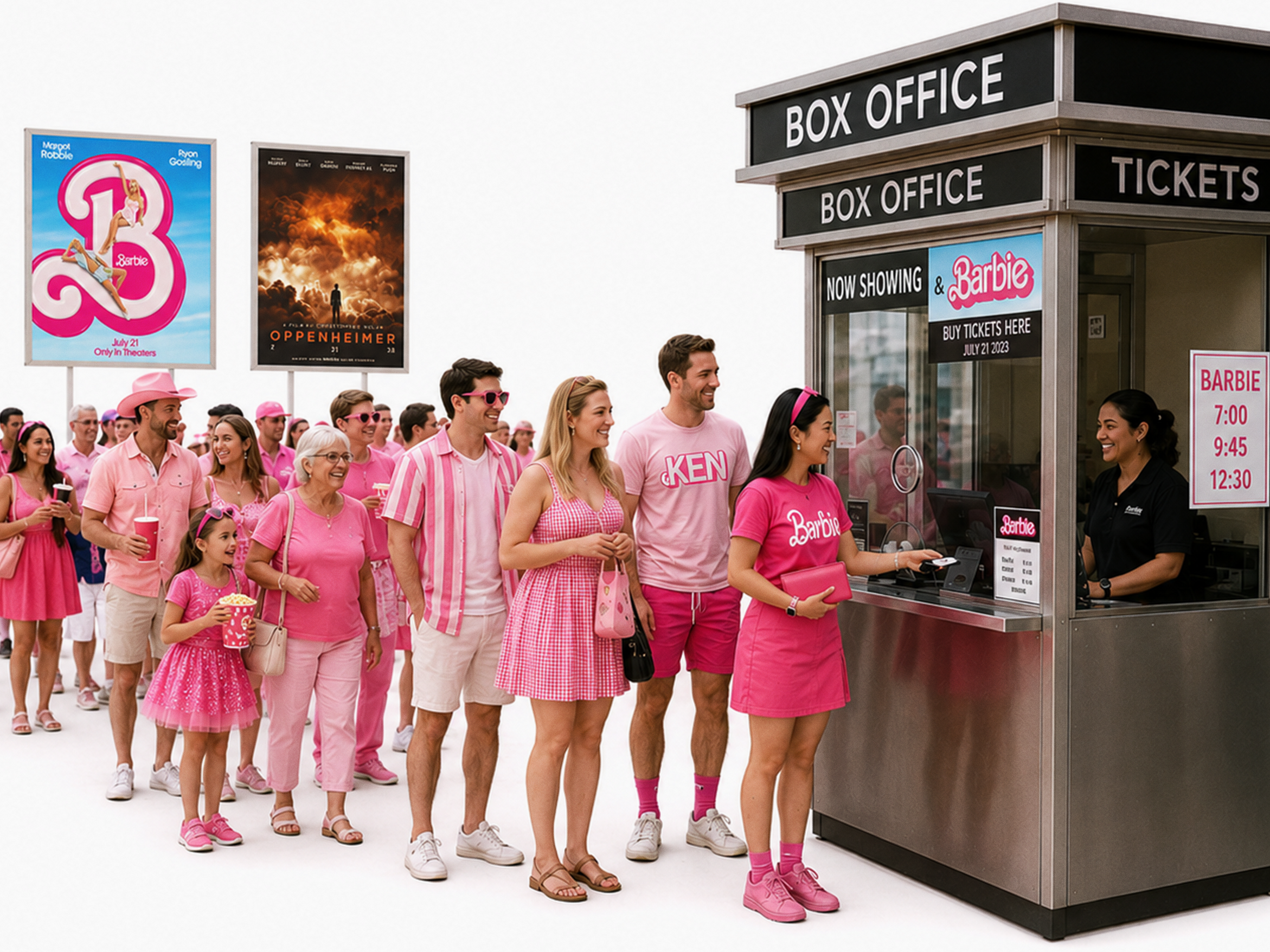
Consumers encountered Barbie while shopping, scrolling social media, visiting cafés, booking hotels and purchasing products that had little connection to cinema. Every touchpoint reinforced the same visual language until Barbie became less like an advertising campaign and more like part of everyday culture.
The rollout remained remarkably disciplined despite its scale. Every collaboration looked and felt like it belonged to the same launch. Nothing appeared disconnected from the central narrative.
Participation also required almost no effort. Wearing pink, sharing memes, visiting installations, or posting photos allowed audiences to become part of the launch long before purchasing a ticket.
The film became the final act of participation rather than the beginning of it.
A launch becomes durable when consumers stop feeling marketed to and start feeling involved.
Where It Leaked
The architecture was exceptionally strong, but not flawless.
The campaign intentionally concealed much of the film’s tone. While this generated discussion, it also left some audiences unsure who the movie was actually for until reviews and word of mouth filled the gap.
Some of the launch’s largest accelerators also emerged outside the original architecture. The “Barbenheimer” phenomenon dramatically expanded attention and extended the cultural conversation. Warner Bros. responded effectively, but the event itself was an organic collision rather than a designed component of the launch.
Finally, many executional mechanics can be replicated. Large partnership programs, immersive installations, and social activations are available to other studios with sufficient resources. What competitors cannot reproduce is Barbie’s cultural equity accumulated over more than sixty years.
The architecture was outstanding. The brand itself amplified it even further.
If Re-Architected
The later stages of the campaign could have communicated the film’s emotional and thematic direction with slightly greater precision while preserving the mystery that made the early marketing so effective.
A more deliberately architected post-premiere engagement system would also have reduced dependence on organic cultural momentum and extended audience participation through designed experiences rather than spontaneous conversation.
Final Assessment
The Barbie launch demonstrated how strong launch architecture can transform attention into participation and participation into cultural momentum. Commercial success followed, but it was the result of a system that was carefully designed long before opening weekend. Execution alone rarely creates a phenomenon. Architecture gives it somewhere to grow.
Launch Rating: 9.4 / 10
Attention can be bought.
Participation must be designed.