
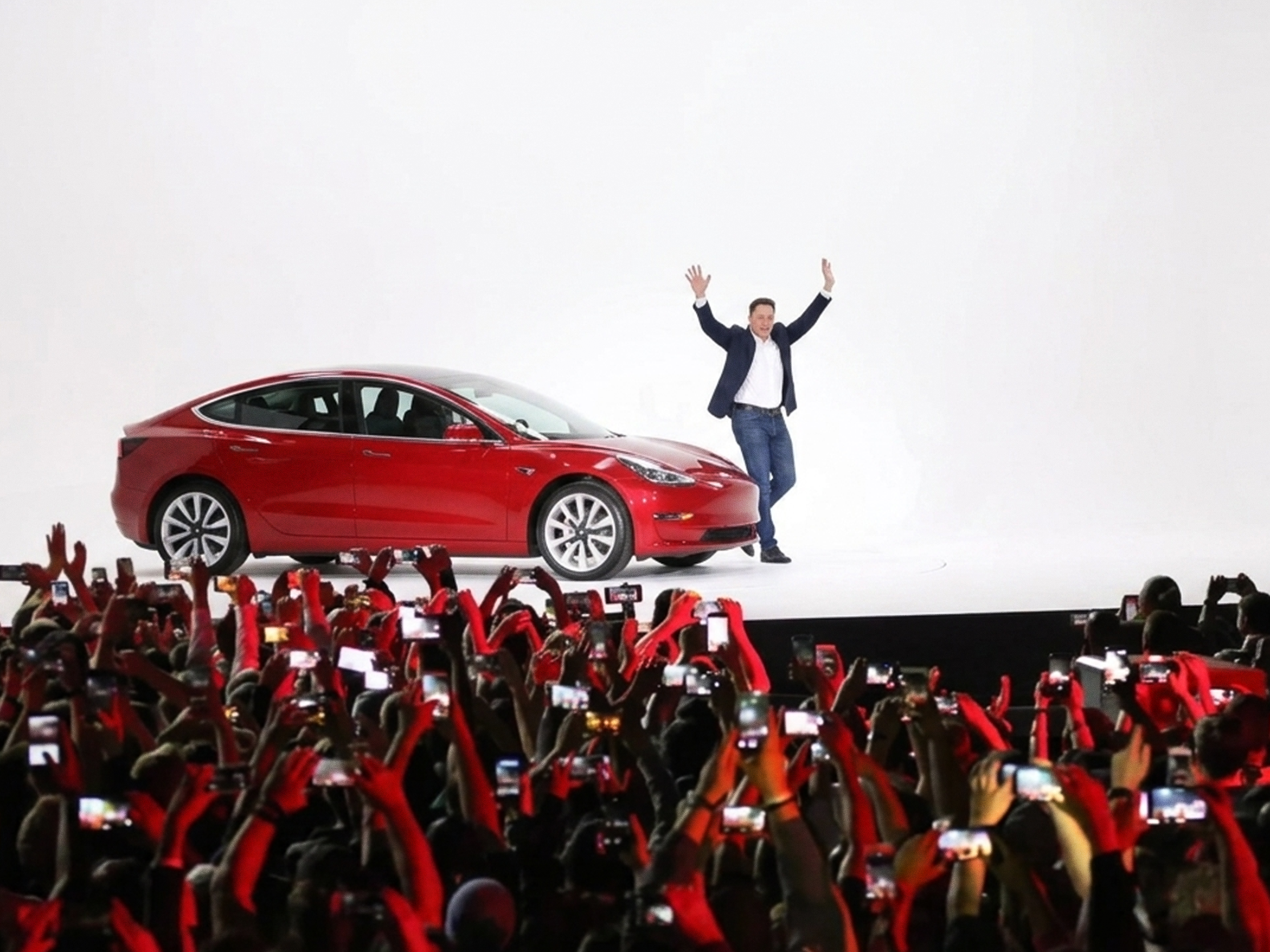
The launch that turned pre-orders into industrial capital.
Context
Tesla unveiled the Model 3 in March 2016 as its first mass-market electric vehicle, with a starting price of $35,000 and a clear ambition: transform Tesla from a premium automaker into a globally scaled transportation company.
The launch also served as a major execution pillar of Elon Musk’s broader Master Plan, Part Deux, which aimed to scale Tesla from premium innovation into mass-market transportation and sustainable energy infrastructure.
Unlike the Roadster or Model S, this was not a luxury demonstration. The Model 3 was Tesla’s structural leap toward mainstream adoption.
Within 24 hours of launch, Tesla secured over 180,000 reservations through $1,000 refundable deposits, despite production not yet beginning. Public anticipation became immediate financial validation.
This was not simply product demand. It was launch as industrial financing.
Strategic Intent
Tesla’s objective was singular:
Scale electric vehicle adoption while simultaneously proving mainstream demand and securing production confidence.
The Model 3 was designed to bridge Tesla’s strategic gap between innovation leader and category-scale manufacturer.
By converting audience belief into preorder capital, Tesla reduced financing friction while signaling enormous market legitimacy.
This launch was engineered not just to sell cars, but to fund expansion.
Narrative & Clarity
Tesla’s value proposition was extraordinarily compressed:
A Tesla for everyone.
This clarity gave the Model 3 exceptional structural power.
Consumers instantly understood:
- Tesla brand prestige
- Lower cost of entry
- EV future accessibility
- Technological leadership
Few modern launches have paired aspiration and accessibility so effectively.
Tesla removed narrative complexity and replaced it with symbolic category expansion.
Structural Architecture
Tesla’s launch architecture was among the strongest in modern consumer product history.
Key structural elements:
- Elon Musk’s founder-led reveal amplified trust and visibility
- Coordinated online + retail reservations created mass participation
- $1,000 deposits converted attention directly into capital
- Public queue lines created social proof spectacle
- Reservation volume itself became media distribution
- Product roadmap reinforced long-term investor and consumer confidence
Tesla engineered launch momentum across:
- Consumer psychology
- Financial markets
- Cultural symbolism
- Manufacturing legitimacy
This was not merely automotive marketing.
It was a coordinated market-construction event.
Where It Leaked
Tesla’s structural leak was not demand.
It was fulfillment.
Production systems were not yet prepared to support the scale generated by launch architecture.
This resulted in:
- Manufacturing bottlenecks
- Delivery delays
- “Production hell”
- Operational credibility strain
Tesla successfully engineered belief faster than it engineered execution.
Demand architecture exceeded operational architecture.
If Re-Architected
- Pace reservation scaling more tightly against production readiness
- Moderate public delivery expectations to preserve operational trust
Final Assessment
Tesla Model 3 remains one of the clearest examples of launch functioning as infrastructure rather than promotion.
Launch Rating: 9.6 / 10
When belief is properly engineered,
a launch can finance the future before the product fully arrives.