When access becomes the product, scarcity becomes the engine.
Context
Supreme did not execute a single defining launch. It engineered a repeatable launch system.
Founded in 1994 in New York, Supreme operated within skate culture but gradually expanded into a broader streetwear and cultural signal. Instead of following traditional fashion cycles (seasonal collections, runway reveals, retail distribution), Supreme introduced a structured weekly release mechanism — later known as the “drop model.”
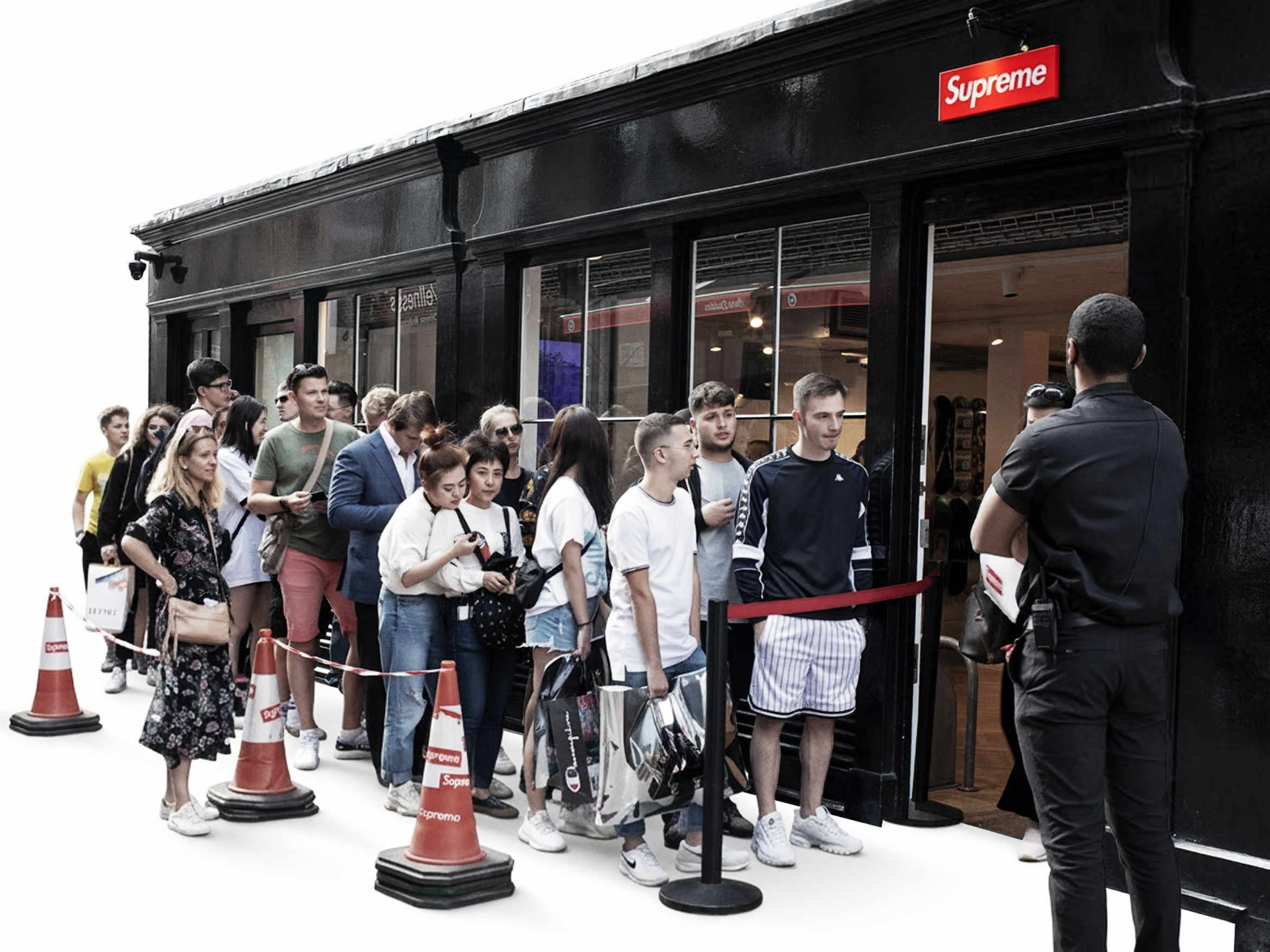
Every Thursday, a limited set of products would release in tightly controlled quantities, both in-store and online. No restocks. No extensions. No second chances.
Over time, this system became the brand’s primary interface with the market. Collaborations with brands like Nike, Louis Vuitton, and The North Face further amplified visibility, but the core architecture remained unchanged: controlled scarcity, predictable cadence, and immediate sellouts.
This was not a campaign layered on top of a product. The release mechanism itself became the product experience.
Strategic Intent
The objective was not to sell clothing.
The objective was to manufacture demand through restriction.
Supreme positioned itself against the logic of mass fashion — where accessibility, availability, and scale define success. Instead, it inverted the equation: value would be derived from inaccessibility.
This created a system where:
- Scarcity signaled status
- Ownership signaled identity
- Participation signaled cultural awareness
The strategy was singular and consistent: restrict supply to amplify perceived value.
Over time, this also aligned with a broader positioning, Supreme was not a clothing brand competing on design or utility. It became a cultural gatekeeper, where access itself was the currency.
Narrative & Clarity
The narrative was extremely compressed.
“Limited drop. Available now. Gone immediately.”
No explanation required. No education needed.
Even for a first-time observer, the system is instantly legible:
- Products release at a fixed time
- Quantities are limited
- If you hesitate, you lose
There is no ambiguity in value proposition. The urgency is embedded, not communicated.
Unlike traditional brands that rely on storytelling, campaigns, or feature articulation, Supreme relies on behavioral clarity. The user does not need to understand the brand, they need to react to it.
This is where the system becomes structurally powerful:
Clarity is not delivered through messaging, but through consequences.
Structural Architecture
1. Fixed Temporal Cadence
Weekly Thursday drops create a ritualized interaction. The market is trained to show up at a specific time, every time.
2. Artificial Supply Constraint
Inventory is deliberately restricted. This is not a byproduct of demand, it is pre-engineered.
3. Zero-Restock Policy
Once sold out, products do not return. This enforces finality and strengthens urgency.
4. Channel Control
Drops are executed through owned channels (flagship stores, official website), maintaining control over access.
5. Queue + Friction Mechanics
Physical lines and digital queues introduce friction, reinforcing perceived value through effort.
6. Collaboration Layering
Strategic collaborations inject periodic spikes of attention without disrupting the core system.
7. Resale Market Amplification
Secondary markets (StockX, Grailed, etc.) extend the lifecycle of each drop, reinforcing scarcity through price escalation and social proof.
8. No Traditional Marketing Dependency
The system itself generates attention. Sellouts become the signal. Visibility is a byproduct of behavior, not spend.
The result is a closed-loop system:
Scarcity → Urgency → Sellout → Social Proof → Increased Demand → Next Drop
Where It Leaked
1. Mechanical Replicability
The drop model has been widely copied.
Brands across fashion, sneakers, and even tech have adopted limited releases and countdown-based launches. Structurally, the mechanics are not protected.
What remains difficult to replicate is the cultural layer, but the system itself is exposed.
2. Over-Reliance on Scarcity
When scarcity becomes the primary value driver, product substance becomes secondary.
This creates long-term risk:
If demand softens, the system has limited fallback mechanisms beyond further restriction or collaboration dependency.
3. Audience Narrowing Over Time
The system reinforces insider participation.
While this strengthens core community identity, it also limits accessibility for new audiences. Growth becomes dependent on cultural relevance rather than structural scalability.
Scarcity scales perception, not necessarily audience.
If Re-Architected
1. Layered Access Tiers
Introduce controlled entry points for new participants without collapsing the core scarcity model (e.g., staggered access or tiered drops).
2. Product-Led Reinforcement
Rebalance emphasis toward product-level differentiation to reduce over-dependence on scarcity as the primary value driver.
Final Assessment
Supreme was not promotional.
It was structurally engineered.
The brand replaced traditional launch cycles with a repeatable system of controlled scarcity, where access itself became the primary unit of value.
Demand was not captured — it was conditioned through rhythm, restriction, and consequence.
Execution did not drive attention. The system ensured it.
Launch Rating: 9.2 / 10
When access is restricted by design,
demand stops being generated and starts being organized.