
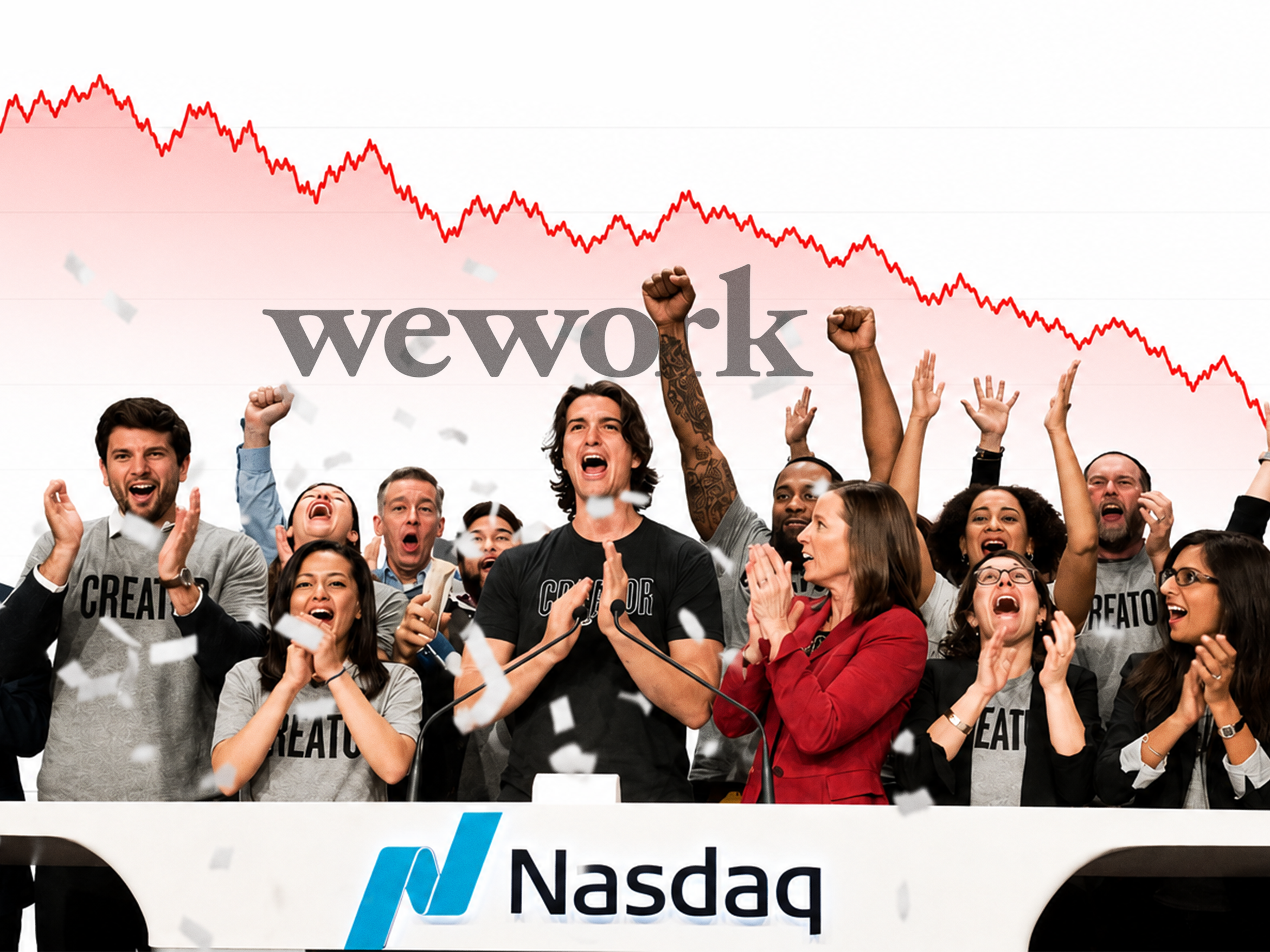
When narrative exceeds structural truth, scale becomes vulnerable.
Context
By 2019, WeWork had grown from a coworking startup into one of the world’s most aggressively valued private companies, fueled by venture capital, founder mythology, and expansion velocity.
Its IPO was designed to convert private valuation momentum into public market legitimacy.
Led by Adam Neumann, the company attempted to position itself not merely as a flexible office provider, but as a transformational platform reshaping how people work, live, and connect.
This was not simply an IPO.
It was a public-market stress test of whether narrative could outweigh fundamentals.
Strategic Intent
The objective was clear: secure large-scale public capital to sustain expansion while validating WeWork as a category-defining enterprise.
However, the strategic fracture emerged immediately.
The launch attempted to present WeWork simultaneously as:
- Real estate infrastructure
- Technology platform
- Cultural movement
- Founder-led visionary company
Rather than compressing into a singular investor thesis, the architecture expanded into contradiction.
Public markets require strategic precision.
WeWork delivered narrative overextension.
Narrative & Clarity
This is where the launch structurally collapsed.
The company’s S-1 filing framed WeWork through abstract ideological language, including ambitions around “elevating the world’s consciousness,” while its underlying economics remained heavily dependent on conventional leasing structures.
The true value proposition was relatively straightforward:
Flexible workspace infrastructure for modern businesses.
Instead, investor-facing communication inflated operational reality into philosophical spectacle.
This created severe narrative dissonance.
Institutional capital does not reward inflated abstraction when business fundamentals remain conventional.
Execution polish cannot compensate for structural confusion.
Structural Architecture
Mechanically, the IPO possessed substantial launch power:
- Massive media coverage
- Strong founder visibility
- Significant brand awareness
- Clear launch moment through S-1 filing
- Existing valuation momentum
But beneath this visibility, structural weaknesses were severe:
- Governance irregularities
- Founder overconcentration
- Profitability concerns
- Valuation inflation
- Misaligned investor positioning
Rather than reducing scrutiny, the launch amplified it.
Public filing transformed private myth into audited architecture.
The founder shifted from growth engine to systemic liability.
The launch was engineered for attention, but not institutional durability.
Where It Leaked
Primary structural failures:
- Narrative inflation beyond credible fundamentals
- Misalignment between investor expectations and founder rhetoric
- Governance vulnerabilities exposed at scale
- Weak financial clarity
- Overdependence on charisma over structural discipline
- Failure to adapt private-market storytelling for public-market scrutiny
WeWork did not fail because it lacked momentum.
It failed because narrative scale exceeded architectural truth.
If Re-Architected
- Reposition WeWork strictly as premium flexible infrastructure with disciplined financial clarity.
- Execute governance restructuring and founder power reduction prior to IPO activation.
Final Assessment
WeWork’s IPO proved that private capital can tolerate mythology far longer than public markets ever will.
Launch Rating: 5.6 / 10
Narrative can manufacture momentum, but not structural legitimacy.