Winning the taste test cost the brand its symbolic advantage.
Context
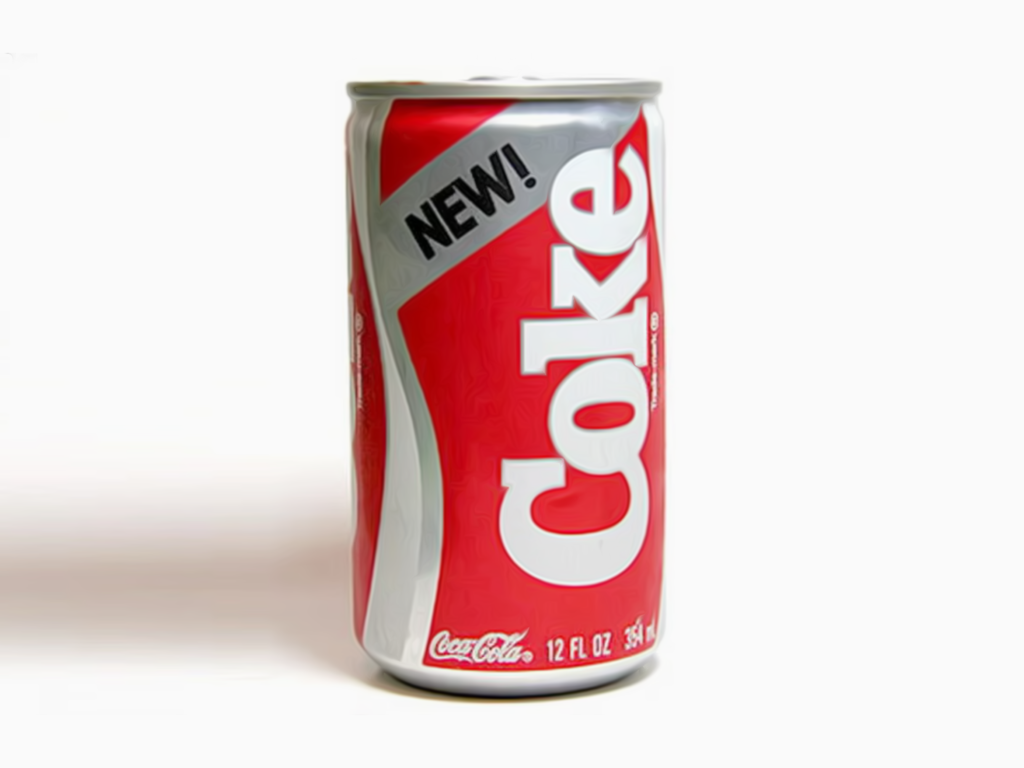
In April 1985, The Coca-Cola Company announced the replacement of its original Coca-Cola formula with a reformulated product branded as New Coke.
This was not a line extension. It was a full substitution. The original formula — a product with nearly a century of brand equity, would be removed from shelves and replaced nationwide.
The stated ambition was performance-driven: win blind taste tests, respond to competitive pressure from PepsiCo, and regain market share in the escalating “cola wars.”
The move was presented as confident modernization. It was architected as a decisive strategic shift.
Strategic Intent
The objective was singular: reclaim taste leadership.
Throughout the early 1980s, Pepsi had positioned itself as the sweeter, younger alternative through highly publicized taste challenges. Coke’s research suggested consumers preferred a slightly sweeter formula in blind testing.
New Coke was an attempt to resolve this competitive tension structurally — not through advertising, but through product reformulation.
The intent was clear. But it underestimated what Coke actually represented.
This was not a feature upgrade. It was a symbolic rewrite.
Narrative & Clarity
From a messaging standpoint, the proposition was simple:
The new formula tastes better.
It could be explained in one sentence. It could be understood within seconds. The announcement was unambiguous, this was the new Coca-Cola.
Clarity was not the issue.
The structural problem was deeper: the narrative reduced a heritage brand to a sweetness comparison.
Coca-Cola was positioned for decades as continuity, memory, ritual, and Americana. New Coke reframed the brand around competitive optimization.
Taste won in a laboratory. Identity lives in culture.
Structural Architecture
The launch mechanics were decisive.
- National press conference (April 23, 1985)
- Immediate formula replacement
- Coordinated distribution shift across U.S. markets
- Clear product renaming
There was no phased rollout. No limited edition test. No dual-product coexistence.
This was a full swap.
From an execution standpoint, the architecture was bold and centralized. There was a defined launch moment, broad media coverage, and operational alignment across bottlers.
But structurally, it removed optionality.
The architecture assumed acceptance. It did not engineer for resistance.
A replacement strategy demands psychological readiness, not just distribution readiness.
Where It Leaked
1. Ownability Collapse
The launch was not rooted in Coca-Cola’s core narrative. It was reactive to Pepsi’s framing. By prioritizing sweetness competition, Coke stepped onto Pepsi’s terrain rather than reinforcing its own.
2. Identity Miscalculation
Consumer backlash was immediate and emotional. The product itself performed well in taste tests, but the removal of the original formula triggered perceived loss.
The company underestimated attachment to familiarity.
Research measured preference. It did not measure meaning.
3. Structural Irreversibility
By fully replacing the original formula, Coke eliminated fallback leverage. There was no contingency architecture built into the launch. Reversal became a public event rather than a controlled iteration.
Within three months, Coca-Cola Classic was reintroduced.
The market corrected the architecture.
If Re-Architected
Two structural adjustments would have changed the trajectory:
1. Parallel Introduction Instead of Replacement
Launch New Coke as a variant rather than a substitution. Preserve the original formula to avoid triggering loss aversion.
2. Narrative Framing Around Expansion, Not Correction
Position the new formula as an addition to evolving tastes, not as an implicit admission that the old version was inferior.
When evolution feels optional, consumers explore.
When evolution feels mandatory, they resist.
Final Assessment
New Coke was not unclear.
It was structurally misaligned.
The company optimized for taste leadership while destabilizing brand heritage, its strongest long-term asset.
Execution polish could not compensate for identity disruption.
Launch Rating: 5.7 / 10
Replacing a century-old symbol requires more than data, it requires architectural humility.