
A cultural outlier repositioned through runway authority.
Context
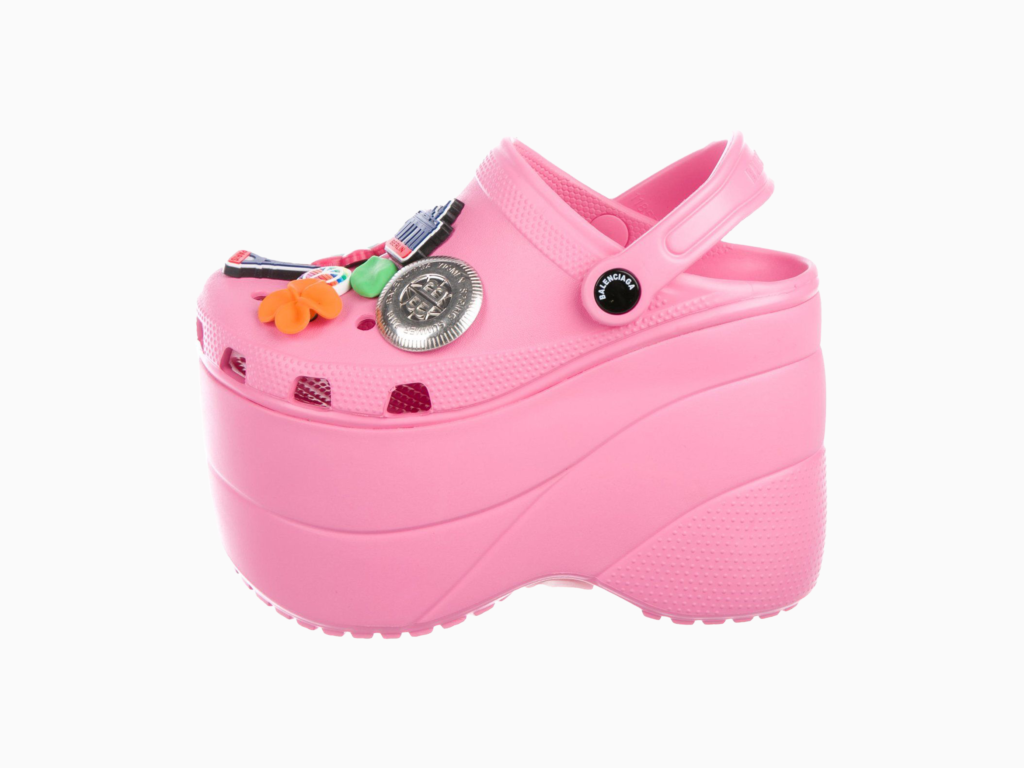
In October 2017, during the Spring/Summer 2018 presentation at Paris Fashion Week, Balenciaga unveiled a collaboration with Crocs. The product: an exaggerated platform version of the classic Crocs clog, presented on the runway and later released at a luxury price point exceeding $800.
The reveal occurred inside Balenciaga’s seasonal runway show rather than through a separate campaign. There was no traditional teaser cycle, no staged brand announcement, and no co-branded storytelling rollout. The shoe appeared as part of the collection — but immediately dominated media coverage.
At face value, the collaboration paired a heritage Parisian fashion house known for couture lineage with a mass-market foam clog widely perceived as unfashionable. The cultural contrast was the mechanism.
The stated ambition was never explicitly framed in a campaign manifesto. However, through pricing, platform elevation, and runway staging, the message was clear: reinterpret an anti-fashion object as high-fashion artifact.
Strategic Intent
The launch appears to have been driven by a singular strategic objective: collapse the divide between luxury prestige and mass-market banality.
Under Demna’s creative direction, Balenciaga had already begun challenging conventional notions of taste and status through irony-infused reinterpretations of everyday objects. The Crocs collaboration extended that trajectory. This was not diversification. It was ideological consistency.
The primary audience was not Crocs’ mass customer base. It was Balenciaga’s high-fashion consumer — particularly those aligned with irony, subversion, and fashion-as-commentary aesthetics. The product functioned as both wearable item and cultural signal.
The objective was meaningful because it reinforced Balenciaga’s evolving brand thesis: luxury is no longer defined by refinement, but by authority over context.
Narrative & Clarity
Few collaborations in fashion history have been as immediately understandable.
The value proposition could be summarized in one sentence:
Crocs reimagined as elevated luxury runway footwear.
There was no narrative complexity. The shock was visual. The exaggeration — platform height, high price — made the positioning unmistakable. Within seconds of runway exposure, audiences understood the statement.
Differentiation was absolute at the time. While fashion frequently reinterprets streetwear and utilitarian garments, transforming a widely ridiculed foam clog into an $800 runway piece was structurally distinct.
The clarity was not dependent on copywriting, founder explanation, or campaign storytelling. The product itself was the narrative.
Execution polish cannot compensate for structural confusion. In this case, there was none.
Structural Architecture
The primary launch mechanism was the Paris Fashion Week runway — one of the highest attention-density nodes in the global fashion calendar. This provided:
- Concentrated industry presence
- Immediate editorial amplification
- Organic social media virality
- Cultural authority validation
There was no fragmented rollout. The reveal occurred within a controlled environment where Balenciaga owned the stage.
Timing also mattered. In 2017, fashion was deep within the normcore and irony-driven aesthetic cycle. Instagram was accelerating meme propagation. The product’s absurdity was inherently shareable.
However, the launch architecture beyond the reveal was relatively minimal. After the runway shock, momentum relied heavily on:
- Press reaction
- Social commentary
- Delayed retail availability
There was no visible multi-phase narrative expansion, no engineered education layer, and limited structured anticipation between reveal and retail drop. Scarcity and price acted as implicit conversion filters.
The launch was powerful at ignition. Less engineered in sustained sequencing.
Where It Leaked
1. Limited post-reveal scaffolding.
The runway reveal generated explosive awareness, but the transition from spectacle to structured demand-building was understated. Momentum extended naturally, not architected deliberately.
2. Ambiguity of broader product ecosystem.
The collaboration functioned primarily as a symbolic object rather than part of a larger footwear strategy. It reinforced brand narrative but did not visibly expand into a scalable architecture.
3. Urgency mechanics were implicit, not explicit.
While fashion scarcity operates by default, there was no clearly articulated, time-bound activation layer beyond eventual retail availability.
The disruption was sharp. The system supporting it was lighter.
If Re-Architected
- Introduce a short, controlled narrative phase between runway reveal and retail release — framing the collaboration as a thesis statement rather than a spectacle.
- Engineer a tighter retail drop window with explicit scarcity signaling to convert viral attention into measurable urgency.
These adjustments would not change the idea. They would strengthen the conversion architecture around it.
Final Assessment
Balenciaga x Crocs (2017) was structurally strong because it was ideologically aligned, instantly comprehensible, and culturally well-timed. The collaboration did not rely on layered storytelling or engineered funnels; it relied on authority and contrast.
Its primary strength was clarity fused with ownability. Its primary leak was limited post-reveal system design.
Luxury brands often chase relevance through ornamentation. This launch pursued relevance through tension.
Launch Rating: 8.3 / 10
Status is rarely inherent; it is architected.